
All-or-Nothing Thinking
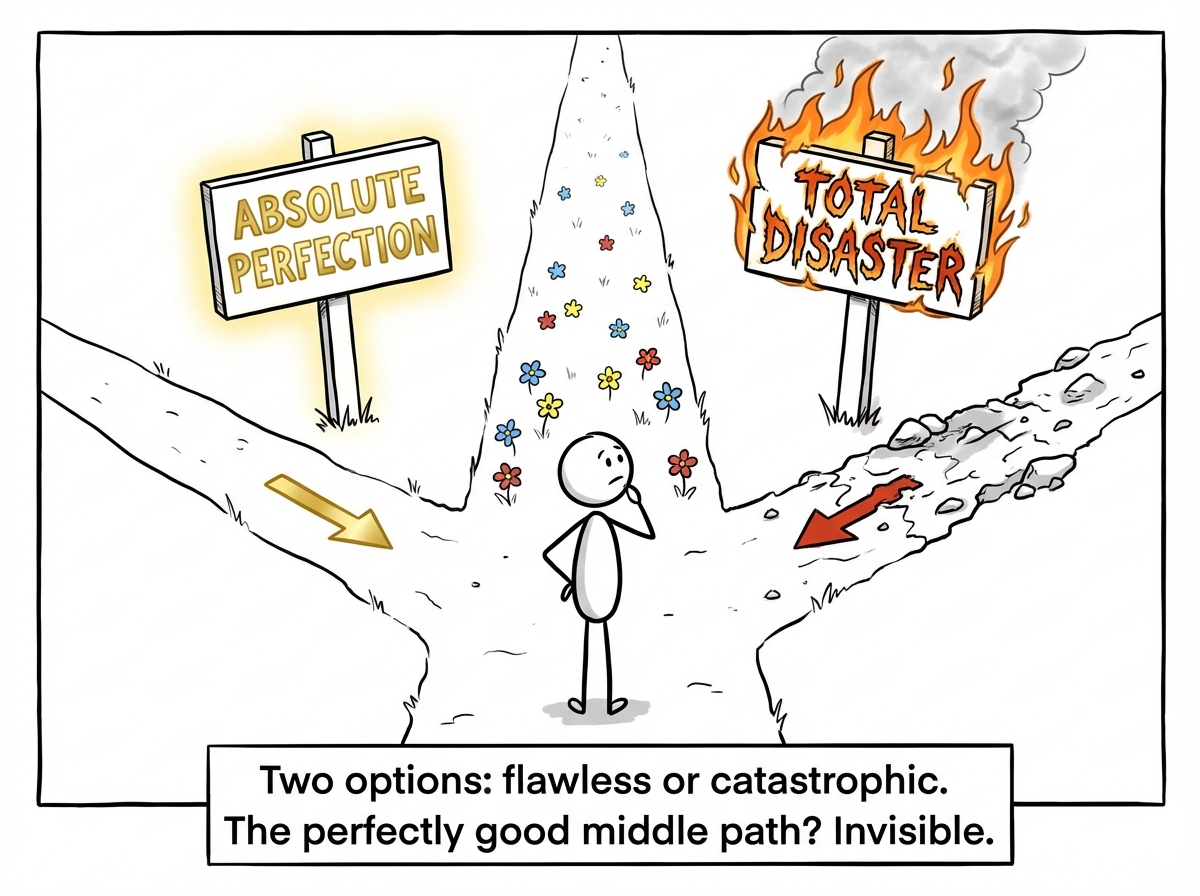
The cognitive distortion that turns everything into extremes -- if it is not perfect, it is a complete failure -- with no room for anything in between.
Explanation
All-or-nothing thinking, also called black-and-white thinking or splitting, is one of the most common cognitive distortions. It is the tendency to evaluate situations, people, or yourself in extreme, either-or categories with no middle ground. You are either a success or a failure. The relationship is either perfect or doomed. The diet is either flawless or completely ruined by one cookie. There is no spectrum, no nuance, no gray area. This distortion is particularly destructive because real life is almost entirely gray area. A presentation that went mostly well but had one awkward moment was not a disaster -- it was a normal presentation. A friend who forgot your birthday is not a terrible person -- they are a human who forgot something. A day where you got seven things done but did not finish the eighth is not a wasted day -- it is a productive day. But all-or-nothing thinking collapses the entire spectrum into two options: perfect or worthless. The practical damage is significant. All-or-nothing thinking drives perfectionism ('if I can not do it perfectly, I will not do it at all'), self-sabotage ('I already missed one workout this week so the whole week is ruined'), and relationship instability ('one fight means we are not compatible'). The antidote is practicing what therapists call 'both/and' thinking instead of 'either/or' thinking. The presentation was both imperfect and successful. The relationship has both problems and genuine love. You are both struggling and making progress. Life happens in the space between extremes.
Key Takeaway
Life is not pass/fail -- it is a spectrum, and most of the good stuff lives in the messy middle.
A stick figure standing at the fork between 'Perfect' and 'Failure,' then noticing the middle path for the first time
The stick figure stepping onto the middle path labeled 'Good Enough' with a hesitant but curious expression
The stick figure looking back at a day that was 70 percent productive and choosing to call it a good day instead of a failure
The stick figure walking comfortably on the middle path, which is full of flowers and nuance, looking more relaxed than either extreme