Relationships
How you connect, communicate, and navigate closeness with other people.
18 topics
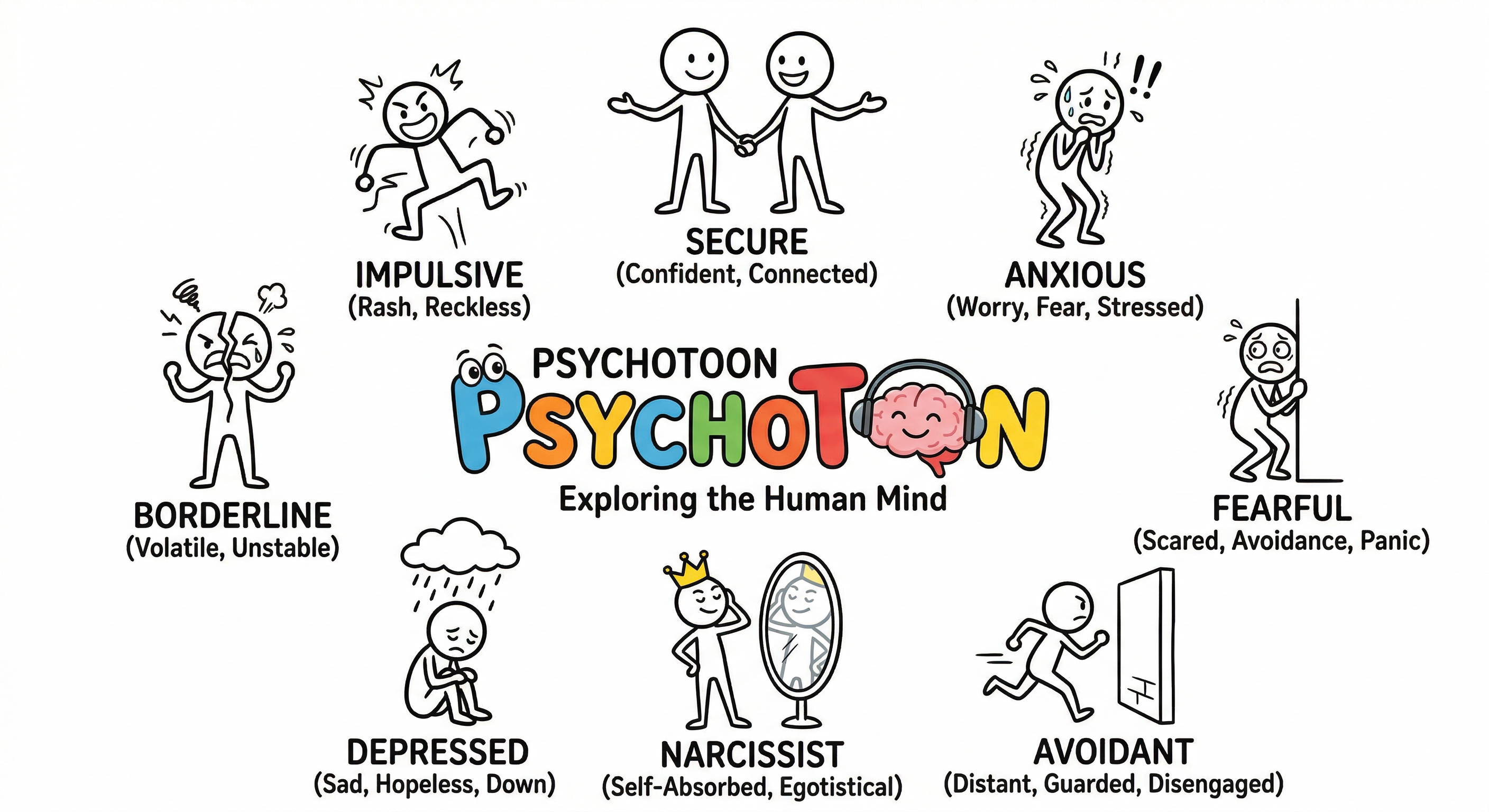
Cognitive biases, therapy techniques, emotional intelligence, and more — illustrated in a way that makes complex psychology topics easy to understand and remember.
Explore psychology topics organized by theme — from relationships to therapy concepts.
How you connect, communicate, and navigate closeness with other people.
18 topicsThe inner patterns that shape how you see yourself and move through life.
15 topicsHow your thoughts and feelings work — and what happens when they get stuck.
10 topicsDeeper psychological frameworks that explain why you do what you do.
10 topicsHealing the younger parts of yourself that still carry old wounds, unmet needs, and outdated survival strategies.
6 topicsHow your family system shaped the roles you play and the patterns you repeat.
7 topicsWhat happens when something ends, changes, or was never yours to begin with.
6 topicsWhat happens when your body keeps the score and your mind refuses to stop.
6 topicsThe gap between who you became to survive and who you actually are.
11 topicsThe things you do to not feel the things you feel.
10 topicsThe personality patterns built on exploitation, entitlement, and the absence of empathy.
6 topicsThe hidden dynamics of power, performance, and identity that play out at work.
8 topicsWhat trauma does to your mind and body — and what healing actually looks like.
7 topicsHow different brains work, struggle, and adapt in a world that was not built for them.
7 topicsHow culture, systems, and social forces shape your inner world without you noticing.
8 topicsThe words you say, the ones you swallow, and everything that gets lost in between.
8 topicsRaising humans while trying to heal the one you already are.
6 topicsThe psychology of modern dating — why you swipe, settle, spiral, and sometimes run.
4 topicsThe psychology of how you see, feed, move, and live in the body you have.
5 topicsThe quiet belief that something is wrong with you — and the armor you built around it.
6 topicsWhat happens when desire, vulnerability, and your whole psychological history show up in the same room.
5 topicsThe existential questions that get louder the longer you are alive.
5 topicsWhat your brain does when you finally stop telling it what to do.
5 topicsThe stories you inherited about money, and the ones you are still living out.
5 topicsThe relationships nobody teaches you how to grieve, maintain, or walk away from.
6 topicsThe gap between wanting to move and actually moving — and what is really holding you back.
5 topicsThe need to hold the reins — and what falls apart when you finally let go.
5 topicsThe psychology of making things — and everything that stops you from starting.
5 topicsHow trust is built, broken, and sometimes rebuilt — and the scars that stay either way.
5 topicsThe exhausting pursuit of flawless — and the person it leaves behind.
5 topicsWhy knowing what to do and actually doing it are two completely different psychological events.
5 topicsHow screens, algorithms, and digital life reshape your brain, relationships, and sense of self.
8 topicsThe newest additions to the Psychotoon collection.
A woman takes a selfie, applies a filter that smooths and reshapes her face, then looks in the real mirror and feels disappointed by her actual reflection -- until she practices seeing what is real instead of what is 'better.'
A person posts something personal and lets the comment section become their mirror -- mood soaring with praise and crashing with criticism -- until they reclaim their own self-image.
A person maintains two versions of themselves -- the polished online persona and the messy real human -- until the gap becomes so wide that the real self starts feeling like the fake one.
A person goes from perfectly content at home to spiraling about exclusion after seeing friends at a party on social media -- only to realize the fear was never about the party.
A child goes from playing freely to performing for cameras in every moment, eventually forgetting how to just be a kid without an audience.
A person realizes their phone is the first thing they reach for every morning and the last thing they see every night, bookending their days with someone else's content instead of their own thoughts.
Visual learning isn't just fun — it's backed by research.
The picture superiority effect shows that people remember images far better than words alone. Cartoons turn abstract concepts into memorable visual scenes.
Cartoons distill multi-layered psychological theories into their essential elements, giving you a clear mental model to build on.
Humor and relatable scenarios create an emotional connection with the material, which research shows deepens encoding and long-term recall.
Whether you're a student, professional, or simply curious, cartoons lower the barrier to understanding important psychological ideas.