
The Emotional Property Line
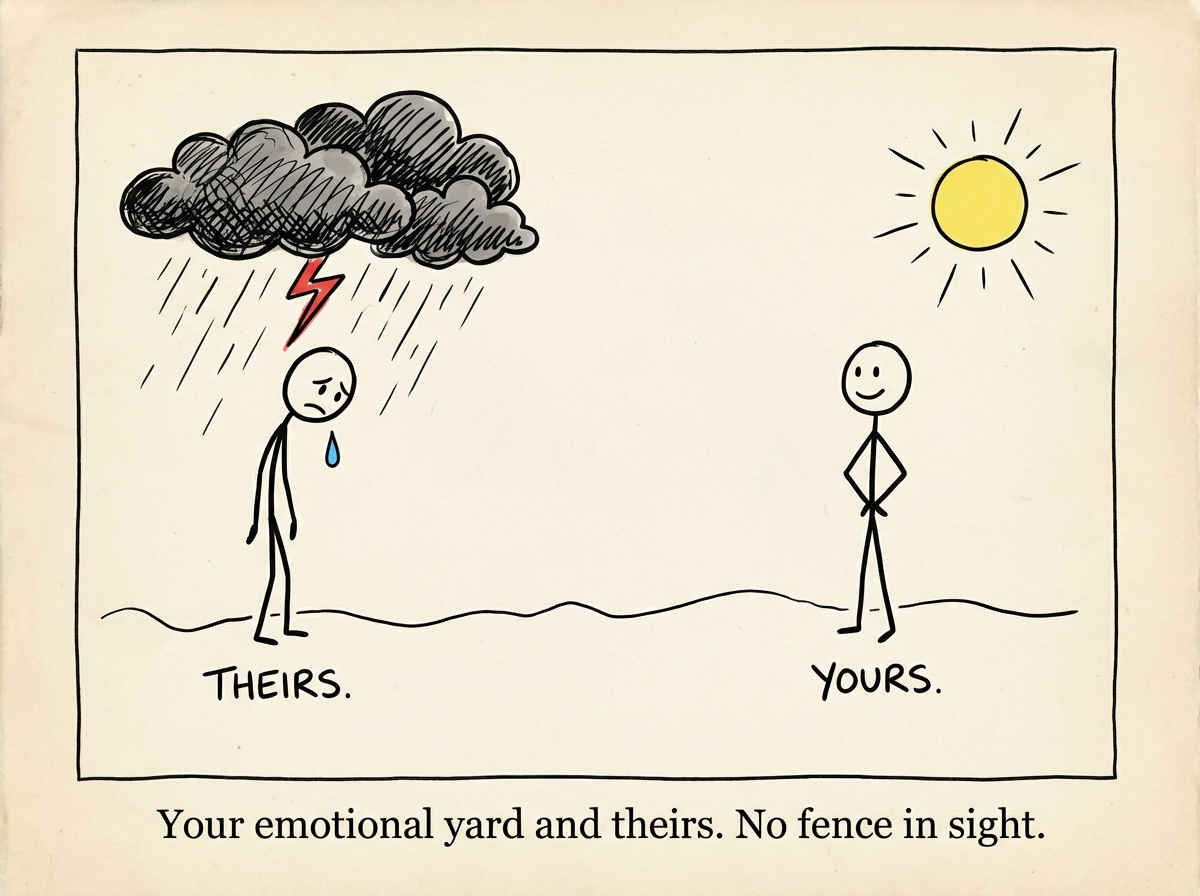


Two people's emotional yards have no fence between them -- one person's feelings flood into the other's property and vice versa, making it impossible to tell whose emotions belong to whom.
Explanation
You walk into a room and your partner is in a bad mood. Within minutes, you are in a bad mood too -- not because anything happened to you, but because their emotional weather became yours automatically. Or maybe it works the other way: you feel guilty for being happy when someone you love is struggling, as if your joy is somehow an act of betrayal. When there is no emotional property line between you and the people you care about, every feeling becomes shared territory, and you lose the ability to experience your own emotions independently. Murray Bowen's concept of differentiation of self describes this phenomenon precisely. People with low differentiation have what Bowen called 'emotional fusion' -- their emotional systems are so intertwined with others that they cannot separate their own feelings from the feelings of those around them. This is not empathy, which involves understanding someone else's emotions while maintaining your own perspective. This is emotional absorption -- taking on another person's internal state as if it were your own. It often originates in families where emotional boundaries were nonexistent, where one person's anxiety became everyone's emergency, and where having a separate emotional experience felt like disloyalty. Building an emotional property line does not mean becoming cold or disconnected. It means developing the ability to stand next to someone's pain without drowning in it. It means being able to say 'I see that you are upset, and I am here for you' without automatically becoming upset yourself. It means your emotional yard is yours to tend -- and theirs is theirs. You can visit each other's yards. You can help with the gardening. But you do not have to live in someone else's weather to prove you care about them.
Key Takeaway
You can care about someone's feelings without carrying them. Their yard is not yours to mow.
A stick figure walking into a room where their partner is upset, pausing to check in with themselves: 'How was I feeling before I walked in here?'
The stick figure saying 'I can see you are upset. I am here for you' while keeping their feet firmly on their own side of the fence
Both figures talking across the friendly fence, one venting while the other listens with compassion but without drowning
Both figures in their own yards, weather patterns separate but both waving over the fence, connected without fused