What a Secure Response Actually Looks Like
A person with secure attachment handles the same situations that trigger anxious and avoidant patterns -- with calm, clarity, and self-assurance.

How your early bonds shape the way you love, fight, and connect in adult relationships.
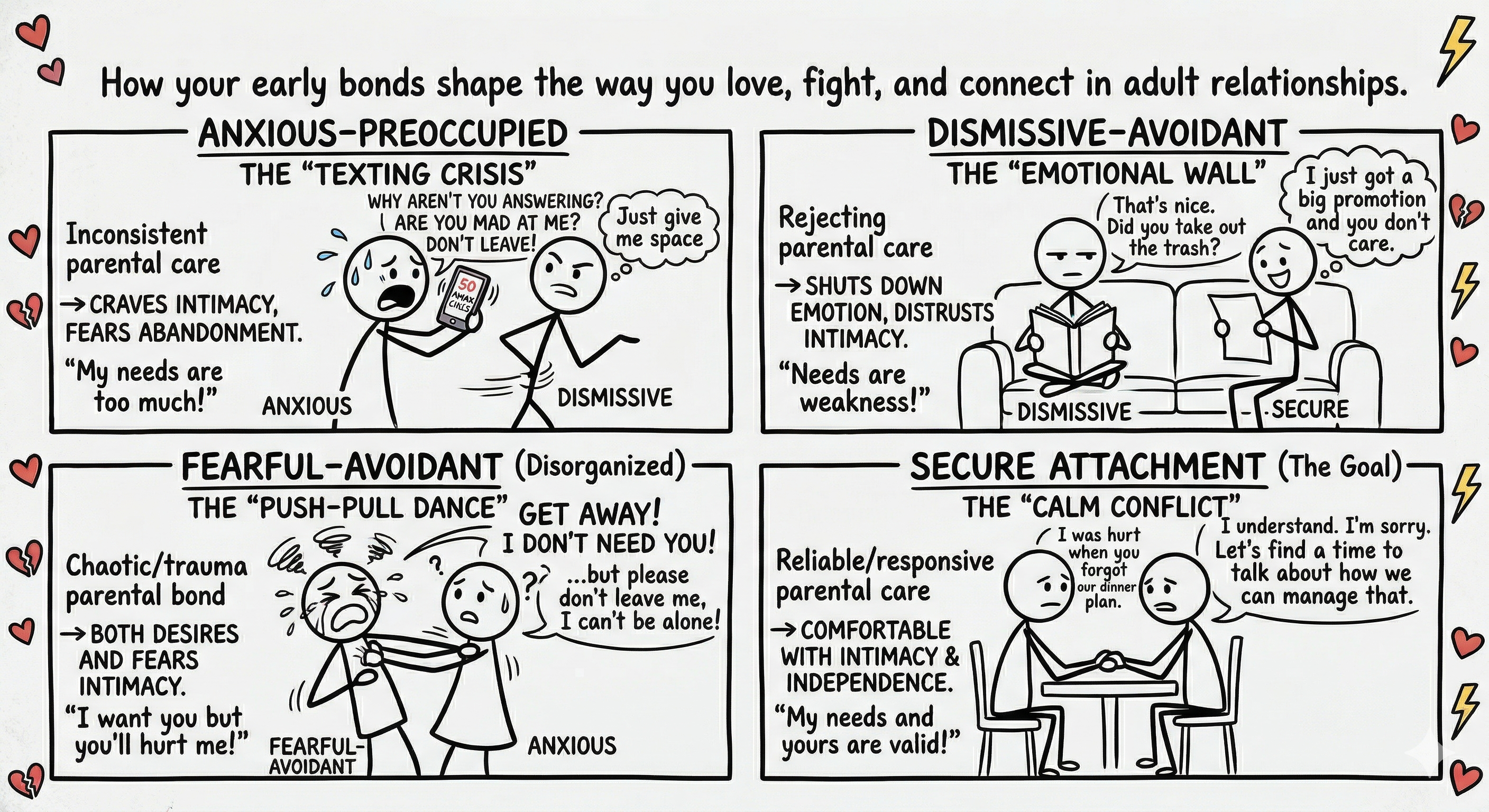
Attachment theory, originally developed by John Bowlby and later expanded by Mary Ainsworth, describes how the bonds we form with caregivers in early life create templates for how we relate to others as adults. There are four primary attachment styles: secure, anxious (also called anxious-preoccupied), avoidant (dismissive-avoidant), and disorganized (fearful-avoidant). Secure attachment looks like comfort with intimacy and independence. Anxious attachment shows up as a deep fear of abandonment and a constant need for reassurance. Avoidant attachment manifests as emotional distancing and discomfort with closeness. Disorganized attachment is a confusing mix of both craving and fearing intimacy. Understanding your attachment style is not about labeling yourself -- it is about recognizing patterns so you can consciously build healthier connections.
Understanding your attachment style is not about labeling yourself -- it is about recognizing your patterns so you can choose a different response.
A stick figure looking at a chart of attachment styles and circling their own pattern with a thoughtful expression
The stick figure noticing their anxious urge to text again, pausing with a hand on their chest instead of reaching for the phone
The stick figure calmly telling a partner 'I feel anxious when I do not hear back, and I am working on it' with an open posture
The stick figure sitting comfortably, phone on the table, reading a book with a small smile -- secure in themselves
A person with secure attachment handles the same situations that trigger anxious and avoidant patterns -- with calm, clarity, and self-assurance.
The classic push-pull dynamic between anxious and avoidant attachment styles, where one person chases while the other retreats in an exhausting cycle.
A person with avoidant attachment pulls away after a moment of genuine emotional closeness, leaving their partner confused about what went wrong.
A person with anxious attachment checks their phone obsessively after sending a text, spiraling through worst-case scenarios when they don't get an immediate reply.