The Burnout Speedometer
A person's internal dashboard with every gauge in the red, but they keep pressing the gas because the check engine light has been on so long they forgot it matters.

The predictable stages of giving too much for too long.
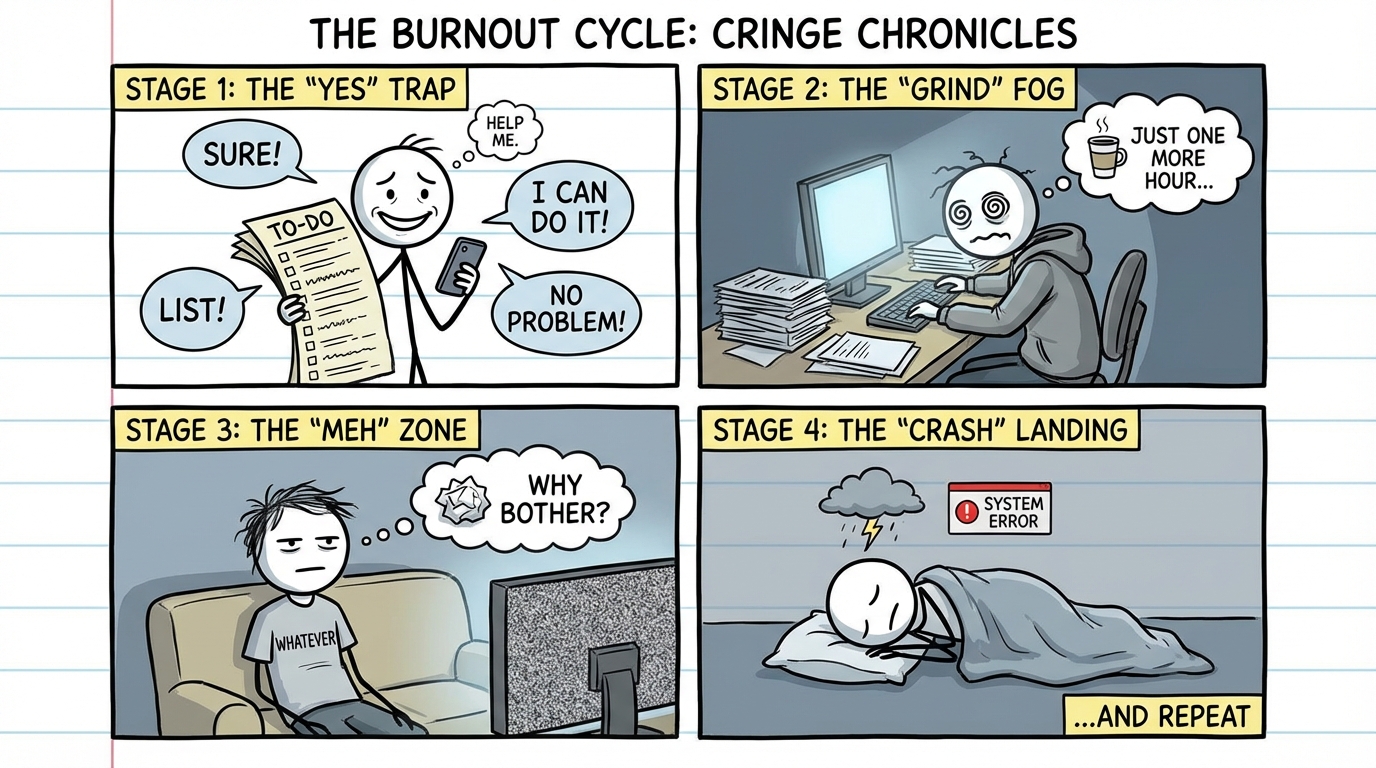
Burnout does not arrive overnight. It follows a remarkably predictable cycle -- one that researcher Herbert Freudenberger first identified in the 1970s and Christina Maslach later expanded into the Maslach Burnout Inventory, the most widely used framework for understanding burnout today. The cycle typically begins with an enthusiastic commitment phase -- you are motivated, energized, and willing to go the extra mile. Then comes the onset of stress: sleep gets shorter, boundaries get thinner, and the to-do list starts feeling like a treadmill. Next is chronic stress, where the symptoms become your baseline -- irritability, fatigue, cynicism, and a creeping sense that nothing you do is enough. Finally, there is the burnout stage itself: emotional exhaustion, depersonalization, and a collapse of the sense of personal accomplishment. The cruelest part of the burnout cycle is that the very qualities that make you vulnerable to it -- conscientiousness, empathy, high standards, a deep sense of responsibility -- are the same ones that make it nearly impossible to recognize it is happening until you are already deep inside it. Your nervous system adapts to the overload, normalizing what should be an alarm signal. Understanding the stages is the first step toward interrupting the pattern before it reaches the point of collapse -- and learning that sustainable effort, not relentless effort, is what actually gets you where you want to go.
The burnout cycle breaks when you start treating your early warning signs as real data -- not noise to push through.
A stick figure pausing to actually look at their internal dashboard, noticing the energy gauge dipping into yellow for the first time.
A stick figure stepping away from a desk mid-task, closing a laptop, choosing to stop before the crash.
A stick figure sleeping in, screen off, a 'Do Not Disturb' sign on the door, gauges slowly moving back toward green.
A stick figure driving again but at a sustainable speed, dashboard in the green, a sticky note on the wheel reading 'Check the gauges daily.'