All-or-Nothing Thinking
The cognitive distortion that turns everything into extremes -- if it is not perfect, it is a complete failure -- with no room for anything in between.

The thinking traps your brain sets for you -- and how to spot them before they spiral.
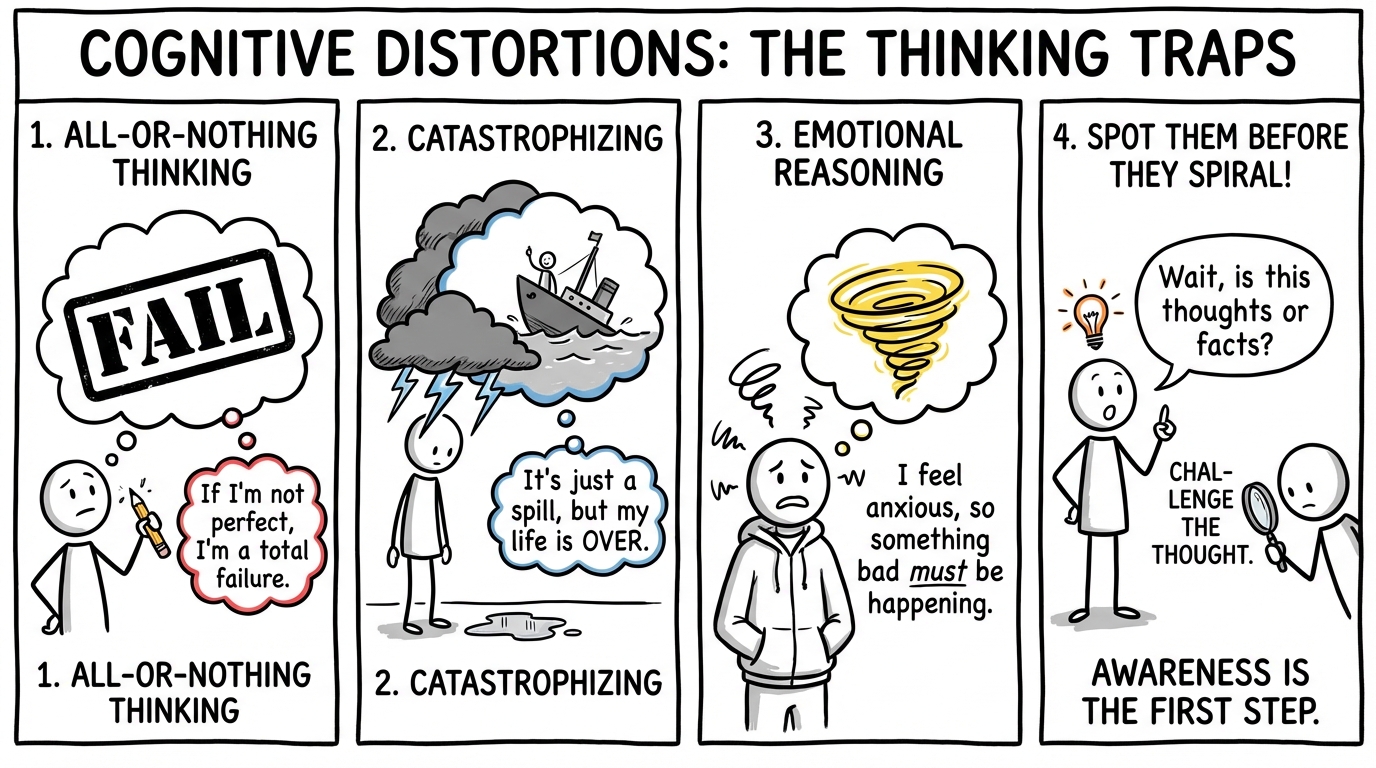
Cognitive distortions are systematic errors in thinking that distort your perception of reality. First identified by psychiatrist Aaron Beck and later expanded by David Burns in 'Feeling Good,' these mental shortcuts feel completely logical in the moment but lead you to conclusions that are exaggerated, irrational, or simply untrue. Common distortions include catastrophizing (assuming the worst will happen), mind reading (believing you know what others think), all-or-nothing thinking (seeing things in black and white), and personalization (assuming everything is about you). Everyone experiences cognitive distortions -- they are a normal part of being human. The goal is not to eliminate them entirely but to develop the awareness to catch them in action. When you can name the distortion, you weaken its grip on your emotions and decisions.
You cannot stop your brain from generating distorted thoughts, but you can learn to name them -- and naming the distortion weakens its grip.
A stick figure having a distorted thought -- 'Everyone thinks I am a fraud' -- and noticing a small label appearing next to it: 'mind reading'
The stick figure holding the distorted thought at arm's length, examining it like a specimen instead of accepting it as truth
The stick figure replacing the distortion with a more balanced thought: 'Some people like my work, some do not, and that is normal'
The stick figure walking forward with the distortion shrunk to a whisper in the background, still present but no longer steering
The cognitive distortion that turns everything into extremes -- if it is not perfect, it is a complete failure -- with no room for anything in between.
A person on a date assumes they know exactly what the other person is thinking -- and acts on those assumptions instead of reality.
A person's brain leaps from a delayed text reply to the absolute worst-case scenario in record time, demonstrating the cognitive distortion of catastrophizing.