The Empty Well
A person drawing from a well to water everyone else's garden while their own garden withers -- and the well is bone dry.

When caring for others drains you dry.
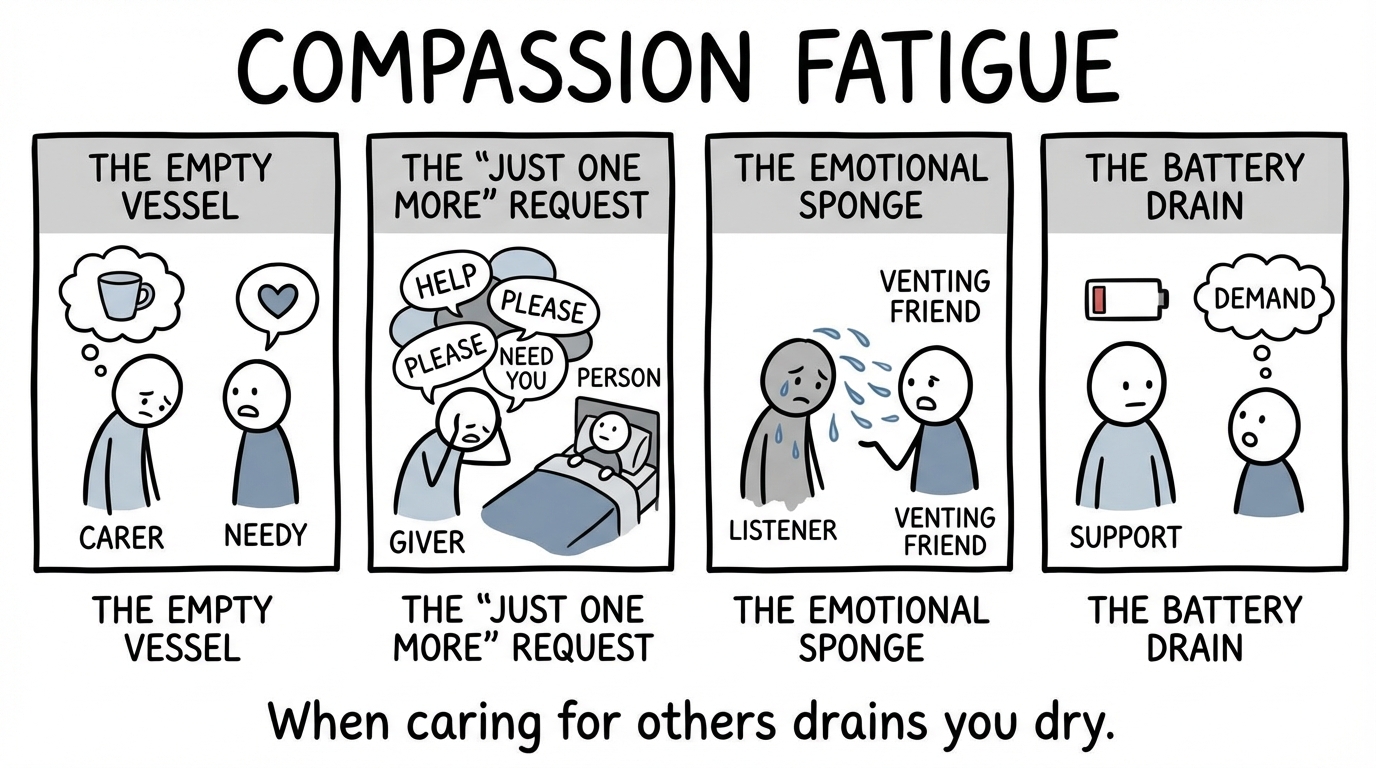
Compassion fatigue is the gradual erosion of your ability to empathize, caused by prolonged exposure to the suffering of others. It was first identified by nurse researcher Carla Joinson in 1992 and later expanded by Charles Figley, who described it as the 'cost of caring' -- a secondary traumatic stress that affects therapists, nurses, social workers, caregivers, and anyone whose role involves absorbing other people's pain. But compassion fatigue is not limited to professionals. It shows up in the friend who is always everyone's therapist, the eldest sibling who held the family together, the partner who carries the emotional weight of the relationship. The symptoms mirror burnout but carry a distinct emotional signature: emotional numbness, a sense of hopelessness about the world, difficulty feeling joy, irritability toward the very people you are trying to help, and guilt about all of it -- because how can you be exhausted by caring when caring is supposed to be a good thing? The paradox is real. The very empathy that makes you good at caring for others is the mechanism that depletes you. Mirror neurons fire as if their pain were your pain, and over time, the nervous system cannot distinguish between witnessing suffering and experiencing it. Recovery from compassion fatigue requires something that feels deeply counterintuitive to natural caregivers: turning that same compassion inward and recognizing that you cannot pour from a cup that is empty -- and you were never meant to try.
Compassion for others that does not include compassion for yourself is not sustainable -- your own garden needs water too.
A stick figure pausing mid-run between other people's gardens, looking down at the empty bucket, finally acknowledging it is dry.
A stick figure gently setting the bucket down and walking toward their own neglected garden, looking guilty but resolute.
A stick figure watering their own cracked soil, a tiny green sprout appearing, tears on their face because it has been so long.
A stick figure tending their own garden which is growing again, still helping a neighbor occasionally but from a refilled well.