The Empty Audience
A child holds up their artwork, their feelings, and their small victories to an audience of empty chairs -- a depiction of what emotional neglect looks like from the inside, and why the wound is so hard to name.

The invisible wound of what did not happen -- the attention, attunement, and validation you needed but never received.
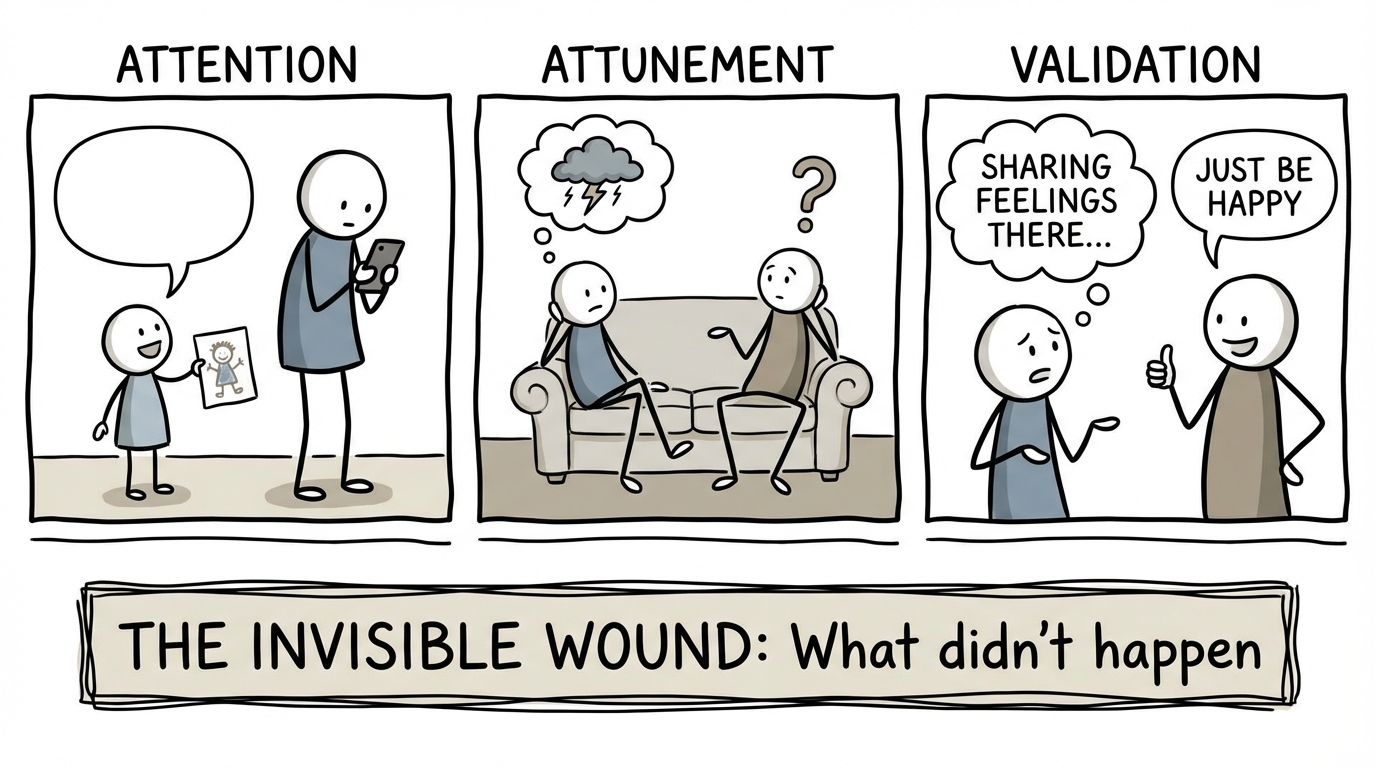
Emotional neglect is not about what happened to you as a child -- it is about what did not happen. It is the absence of adequate emotional attunement, validation, and responsiveness from caregivers. Unlike abuse, which involves harmful actions, neglect is defined by omission. Your feelings were not acknowledged. Your emotional needs were not noticed. You were fed and sheltered but not seen. This makes it one of the hardest wounds to identify, because there is no dramatic event to point to. You cannot say 'this terrible thing happened.' Instead, you are left with a vague sense that something is missing, a chronic feeling of emptiness, and the belief that your emotions do not matter or are too much. Psychologist Jonice Webb, who wrote 'Running on Empty,' describes emotional neglect as a failure of parents to respond sufficiently to a child's emotional needs. The effects are pervasive: difficulty identifying and expressing emotions (alexithymia), feeling disconnected from others, chronic self-blame, a sense of being fundamentally different, and the deep conviction that your needs are a burden. Healing from emotional neglect starts with learning to notice your own feelings -- a skill that was never developed because no one modeled it for you.
Healing from emotional neglect begins with learning to notice your own feelings and treating them as valid -- becoming the attentive audience you never had.
A stick figure pausing mid-day and asking themselves 'Wait -- what am I actually feeling right now?' with a small look of surprise
The stick figure writing in a journal, listing small feelings they noticed -- 'annoyed at the meeting, sad after the phone call' -- practicing emotional awareness
The stick figure telling a friend 'Actually, that comment hurt my feelings' instead of brushing it off with a smile
The stick figure looking at a younger version of themselves and saying 'Your feelings always mattered. I am paying attention now'