The Cart of Feelings
A person's online shopping cart fills with emotions disguised as products, and a massive checkout total changes nothing about how they actually feel.

Buying things to fill holes that things can't fill.
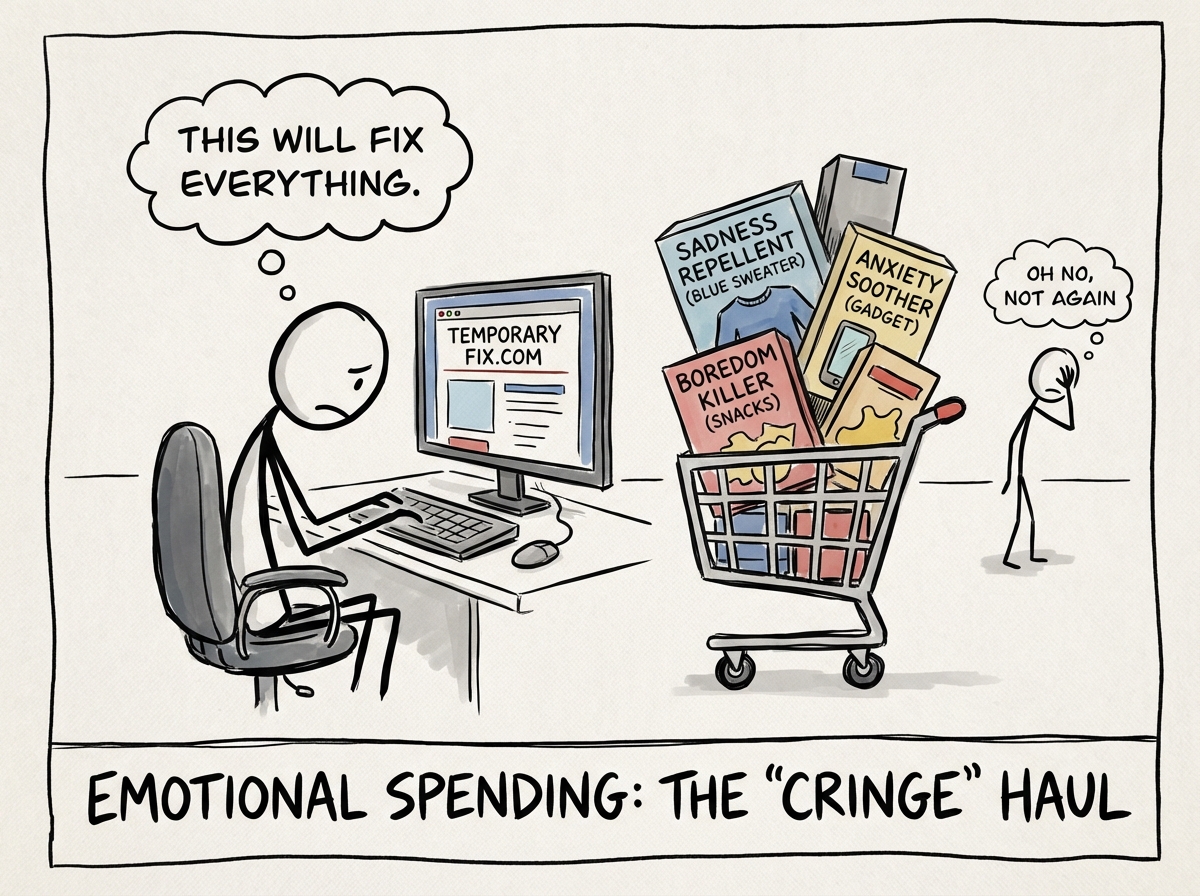
Emotional spending is the act of using purchases to manage feelings that have nothing to do with the thing being purchased. You are not buying the shoes because you need shoes. You are buying them because you had a terrible day, or you feel invisible, or you are trying to outrun a sadness that has been following you since Tuesday. Your shopping cart knows more about your emotional state than you do -- stress shows up as late-night online orders, loneliness manifests as subscription boxes, and inadequacy looks like a closet full of things that were supposed to make you feel like a different person. Research by consumer psychologists shows that the dopamine hit from purchasing is real but devastatingly brief. The anticipation of buying -- the browsing, the imagining, the adding to cart -- generates more pleasure than the actual ownership ever does. This is why the relief never lasts and the cycle keeps repeating. Retail therapy is not therapy. It is a coping mechanism dressed up in clever marketing language. The emotional spender is not materialistic or irresponsible -- they are someone whose emotional regulation system has learned that acquisition is the fastest route to relief. The problem is not the spending itself but the fact that the underlying feeling remains completely unaddressed, waiting patiently under the pile of new purchases for you to finally look at it.
Your shopping cart is an emotional diary -- learning to read it is the first step toward addressing what you are actually feeling instead of what you are buying.