The Meaning Vending Machine
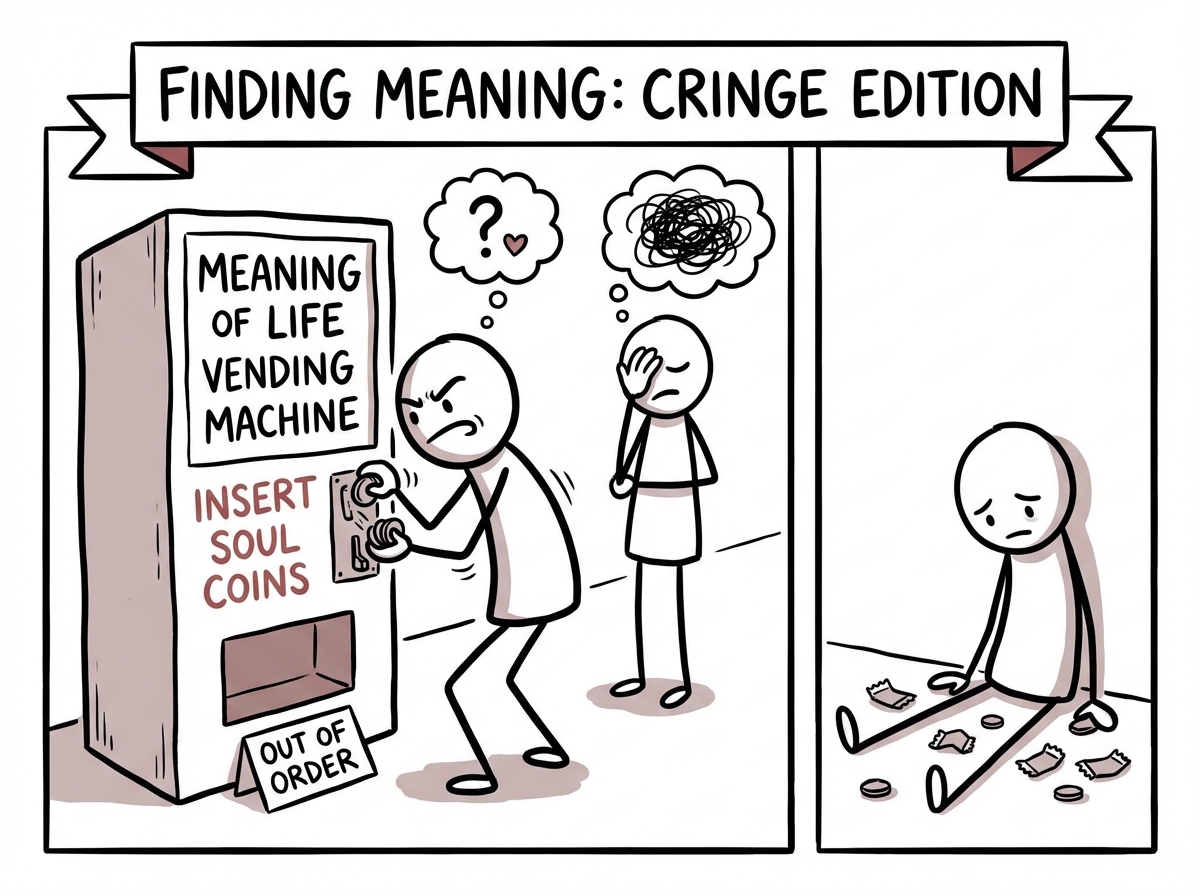
A person keeps feeding coins into a 'Meaning of Life' vending machine that never dispenses anything, until they find meaning by accident while helping a stranger.
What Viktor Frankl understood that self-help missed -- meaning is not found, it is created through how you respond to suffering, work, and love.
Viktor Frankl survived Auschwitz and emerged with an observation that changed psychology: the people who survived the camps were not necessarily the strongest or the healthiest -- they were the ones who had something to live for. His logotherapy, the 'third Viennese school' of psychotherapy after Freud and Adler, is built on a single premise: the primary human drive is not pleasure or power but meaning. Frankl identified three pathways to meaning -- through creative work, through experiencing something or encountering someone (love), and through the attitude you take toward unavoidable suffering. What makes this framework so powerful is what it does not promise. It does not say life will be fair, comfortable, or happy. It says that even in the worst circumstances, you retain the freedom to choose your response -- and that this freedom is where meaning lives. Modern research by Michael Steger and others confirms that a strong sense of meaning is one of the most robust predictors of psychological well-being, resilience, and even physical health. The catch is that meaning cannot be pursued directly. It emerges as a side effect of engaging deeply with something beyond yourself.
Meaning cannot be pursued directly -- it emerges as a side effect of engaging deeply with work, love, and the attitude you take toward unavoidable suffering.