The Loop You Did Not Choose
A person rides a circular track labeled Cue, Routine, and Reward, going around and around without realizing there is an exit ramp they keep passing -- until they finally notice it and take the detour.
Every habit is a three-part loop -- cue, routine, reward -- running on autopilot until you decide to look at the track.
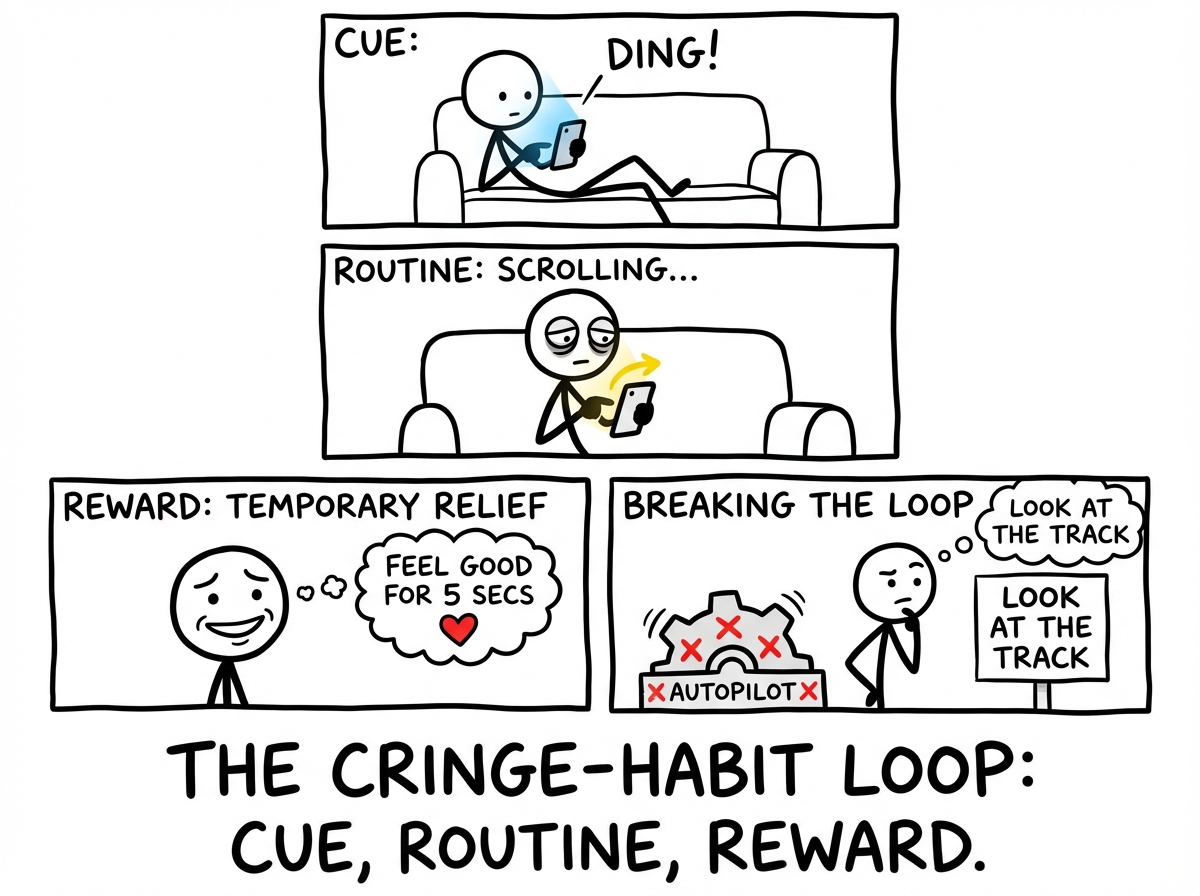
A habit loop is the neurological pattern at the core of every automatic behavior: a cue triggers a routine, which delivers a reward, which strengthens the cue. Charles Duhigg popularized this framework in The Power of Habit, drawing on decades of research from MIT neuroscientists like Ann Graybiel, who showed that the basal ganglia -- the brain's autopilot center -- chunks repeated behaviors into automatic sequences to conserve cognitive energy. This is why you can drive home without thinking about every turn, but it is also why you reach for your phone two hundred times a day without deciding to. The loop is efficient, not intelligent. It does not care whether the routine serves you. It only cares that the reward arrived. BJ Fogg's behavioral research adds an important nuance: the reward does not have to be large. Even a tiny dopamine signal -- the buzz of a notification, the crunch of a chip -- is enough to wire the loop tighter with each repetition. Breaking a habit is not about willpower or motivation. It is about identifying the cue, understanding the real reward you are chasing, and inserting a different routine that delivers a similar payoff. The loop will keep running either way. The only question is whether you are choosing what it runs.
You do not break a habit loop -- you redirect it by keeping the cue and reward but choosing a different routine.