The Unlocked Door Nobody Opens
A person sits on the floor in front of a door they believe is locked, while others walk through it freely, because past experience taught them that doors are never for them.

When past helplessness teaches you that trying is pointless -- even when the cage door is wide open.
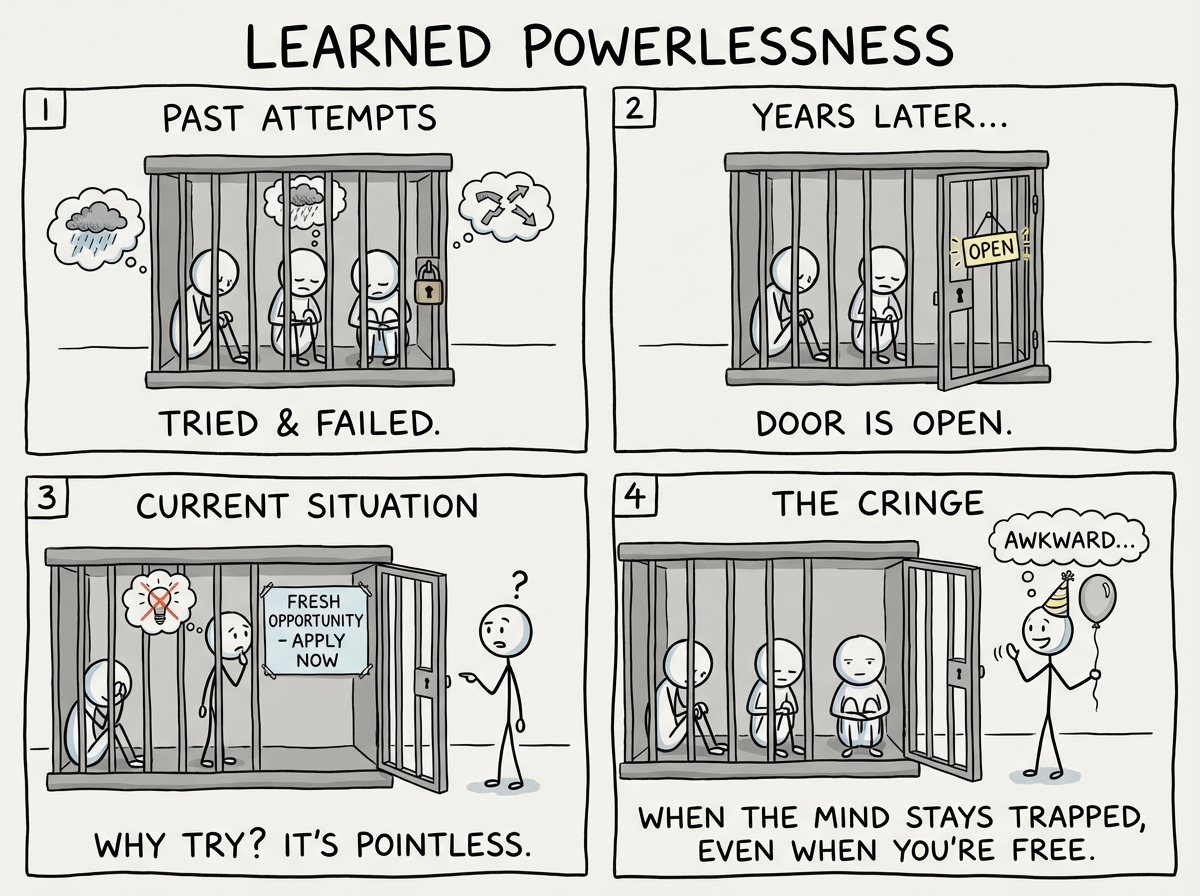
Learned powerlessness -- more commonly known in research as learned helplessness -- is a psychological state in which a person stops attempting to change their circumstances because past experience has taught them that their actions have no effect. The concept originated in Martin Seligman's landmark 1967 experiments, where dogs exposed to inescapable electric shocks eventually stopped trying to avoid the shocks even when escape became possible. The finding revolutionized the understanding of depression, passivity, and human resignation. In humans, learned powerlessness develops when repeated experiences of failure, rejection, or uncontrollable adversity create a cognitive framework that generalizes beyond the original context: 'Nothing I do matters, so why try?' This explanatory style -- internal ('It is my fault'), stable ('It will always be this way'), and global ('It affects everything') -- becomes a self-fulfilling prophecy. Research by Christopher Peterson and colleagues linked this attributional pattern to clinical depression, academic underachievement, and poor physical health. The insidious aspect of learned powerlessness is that it does not require ongoing oppression to persist. The cage can be removed entirely, and the person will still sit inside the space where it used to be. Recovery requires not just opportunity but the slow, frightening process of testing whether the world has changed -- pushing on doors you have spent years believing are locked.
The door has been unlocked for years -- but the hand that was burned once does not reach for handles anymore.