The Old Shoes
A person tries to squeeze into friendship shoes they have outgrown, hobbles painfully while pretending they fit, and finally sets them down with love to walk forward.

When growth means leaving behind the people who knew the old you.
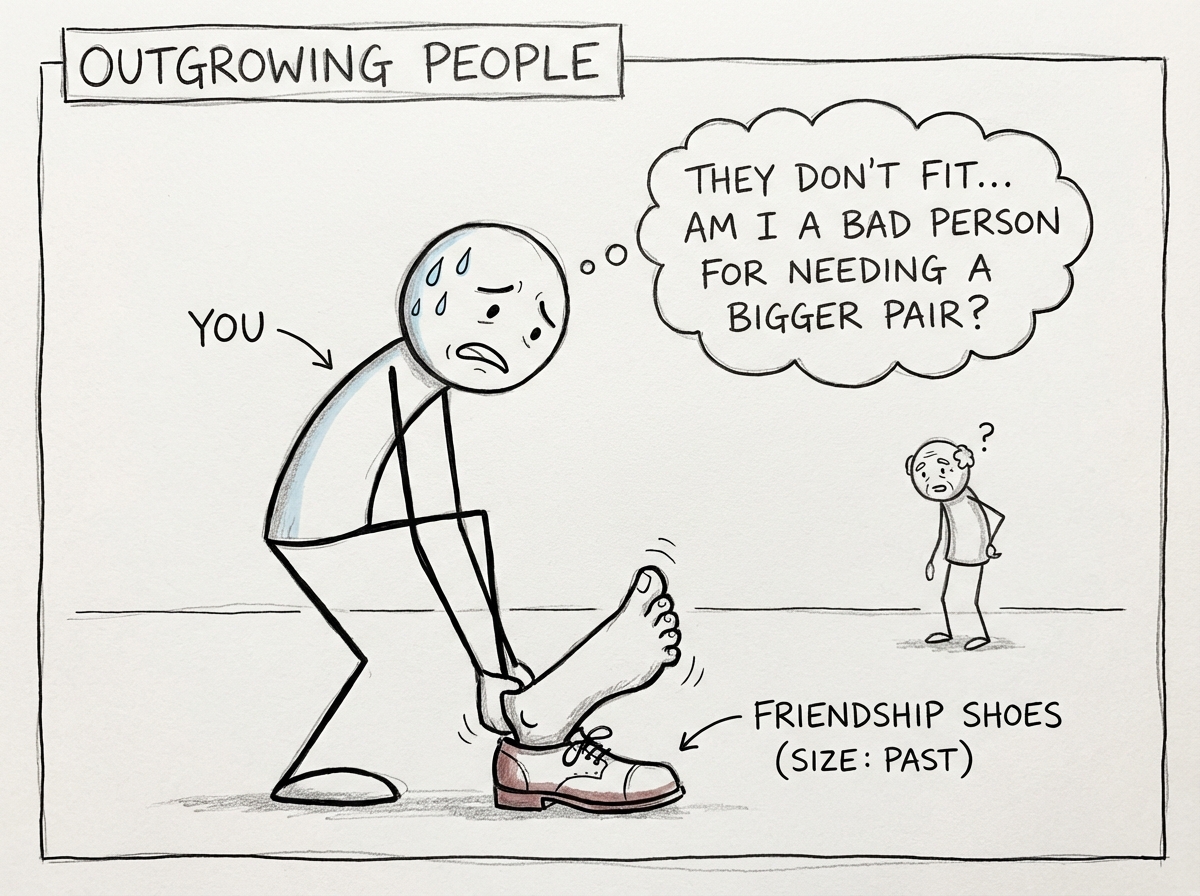
No one warns you that personal growth has a body count. You start therapy, set boundaries, change careers, get sober, find your voice -- and suddenly the people who loved the old version of you do not quite know what to do with the new one. Some adjust. Some quietly disappear. Some actively resist, because your growth is an uncomfortable mirror for their stagnation. Outgrowing people is one of the most painful and least discussed side effects of getting healthier. It carries a specific kind of guilt -- the feeling that by evolving, you are betraying the people who were there when you were smaller. The friend who bonded with you over shared dysfunction. The group that only works when everyone stays at the same level. The family member who needs you to stay in your assigned role. Developmental psychologists have long noted that identity shifts disrupt relational systems. When you change, the implicit social contracts you had with others are violated. People who benefited from your people-pleasing do not celebrate when you start saying no. People who connected with you through cynicism do not cheer when you start hoping. This does not make them bad people. It makes them people who were attached to a version of you that no longer exists. The grief of outgrowing someone is complicated because both things are true at once: you are grateful for what the relationship was, and you recognize it cannot survive who you are becoming. There is no clean resolution. There is only the uncomfortable truth that growth sometimes means walking forward while some people stand still -- and learning to let that be okay without making either of you the villain.
Growth is not betrayal -- and you do not owe anyone the smaller version of yourself just because that is the one they are comfortable with.