The Blank Menu
A former people-pleaser sits at a restaurant staring at a menu that just says 'What do YOU want?' and has absolutely no idea how to answer.

Who am I when I stop performing?
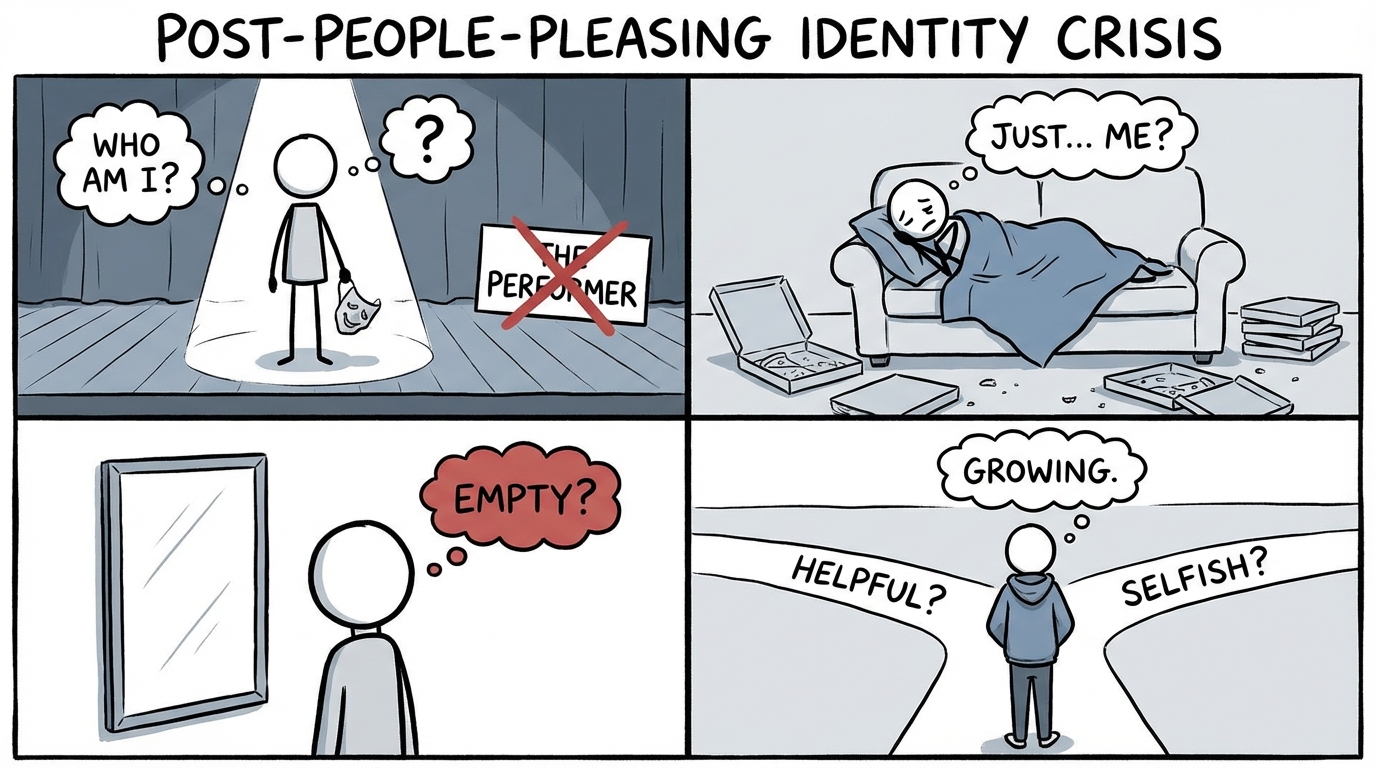
The post-people-pleasing identity crisis is what happens when you finally stop orienting your entire life around other people's needs and preferences -- and realize you have no idea who you are without that role. For years, maybe decades, your identity was built on being helpful, agreeable, accommodating, and easy to be around. You knew exactly what everyone else wanted, and you shaped yourself accordingly. Then one day -- through therapy, burnout, or a breaking point -- you decide to stop. And the silence that follows is terrifying. Without the constant task of managing other people's comfort, you are left face-to-face with a version of yourself you barely recognize. Harriet Braiker, in her work on the 'disease to please,' described how people-pleasing becomes an identity rather than a behavior -- it stops being something you do and becomes who you are. When you remove it, it can feel like there is nothing left underneath. You might struggle with the simplest decisions because you are used to outsourcing your preferences to whoever is in the room. You might feel selfish for having needs, or guilty for taking up space without earning it through service. This crisis, while deeply uncomfortable, is actually a sign of enormous growth. It means you have stopped performing long enough to notice the performance. The emptiness you feel is not proof that you are hollow -- it is the open space where your real self finally has room to grow. Filling that space takes time, patience, and a willingness to sit with not knowing. But the person waiting on the other side of that discomfort is someone worth meeting.
The emptiness after people-pleasing is not proof that you are hollow -- it is the open space where your real self finally has room to grow.
A stick figure sitting with a blank menu, taking a deep breath and saying 'I am allowed to not know yet'
The stick figure making a tiny, low-stakes choice entirely for themselves -- ordering something just because it sounds good
The stick figure saying 'no' to a request without apologizing, looking uncomfortable but holding the line
The stick figure sitting comfortably alone, reading a book they chose, looking peaceful instead of empty