The Never-Enough Jar
A person has a jar labeled 'Enough' that can never be filled no matter how much goes in, until they discover the hole in the bottom labeled 'Childhood' and start patching it.

The deep belief that there will never be enough, no matter how much you have.
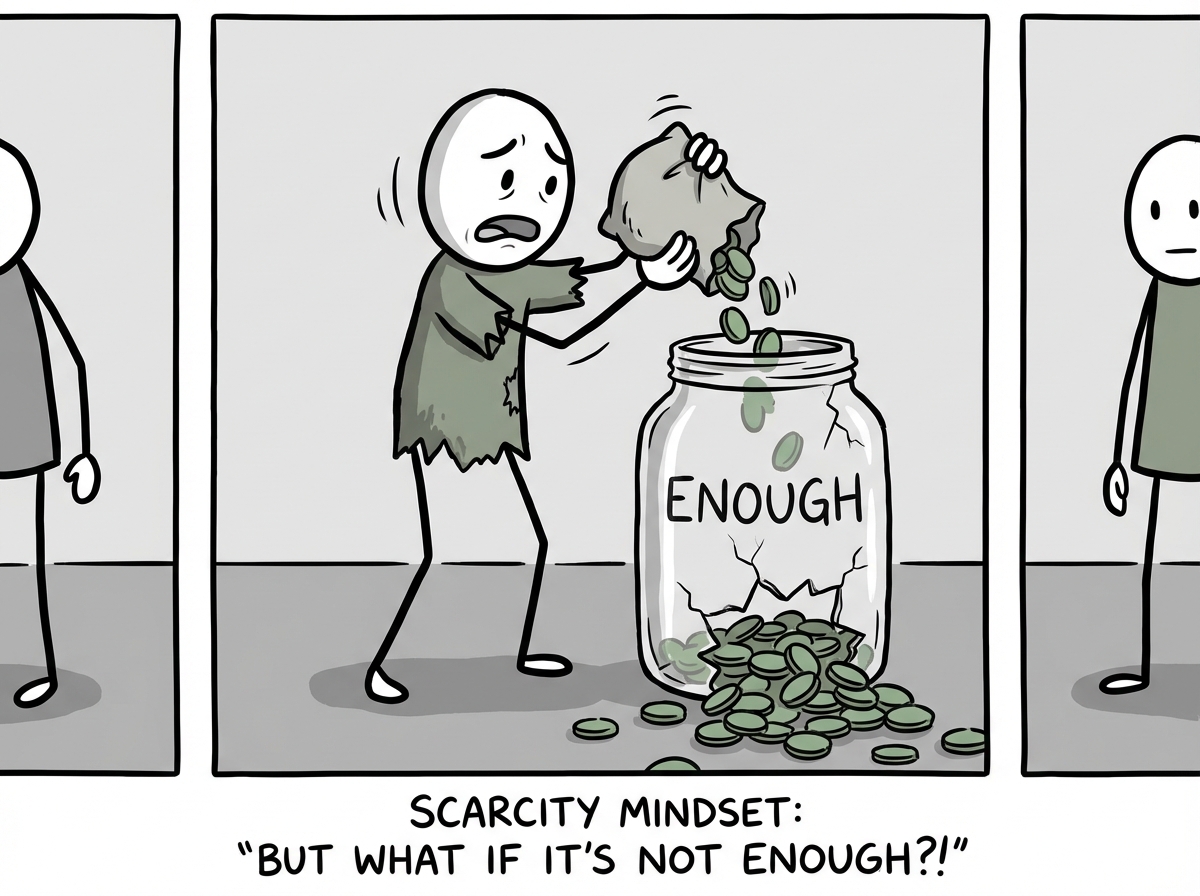
Scarcity mindset is the persistent, bone-deep conviction that there is not enough -- not enough money, not enough time, not enough security -- and that there never will be. It is the voice that tells you to hoard, to panic-save, to never enjoy what you have because it could all disappear tomorrow. Psychologists Sendhil Mullainathan and Eldar Shafir's groundbreaking research in 'Scarcity: Why Having Too Little Means So Much' demonstrated that the experience of scarcity literally changes how the brain functions. It narrows focus, reduces cognitive bandwidth, and makes it nearly impossible to think long-term. Growing up with not enough -- not enough food, not enough stability, not enough of anything you needed -- rewires your brain's threat detection system so that it stays locked in survival mode even when the danger has passed. This is why people who grew up poor can earn six figures and still feel the terror of running out. The scarcity is no longer in the bank account; it is in the nervous system. Financial therapists note that scarcity mindset does not just affect spending -- it affects relationships, career decisions, and the ability to rest. When your body believes that safety is always one paycheck away from collapsing, generosity feels reckless, rest feels irresponsible, and enough never actually arrives.
The scarcity is no longer in your bank account -- it is in your nervous system, and no amount of money can fix what your body still believes about safety.