The Highlight Reel Trap
A person scrolling social media watches their own perfectly fine life shrink with every scroll until they put the phone down and it returns to normal size.

The reflex to measure your life against everyone else's highlight reel.
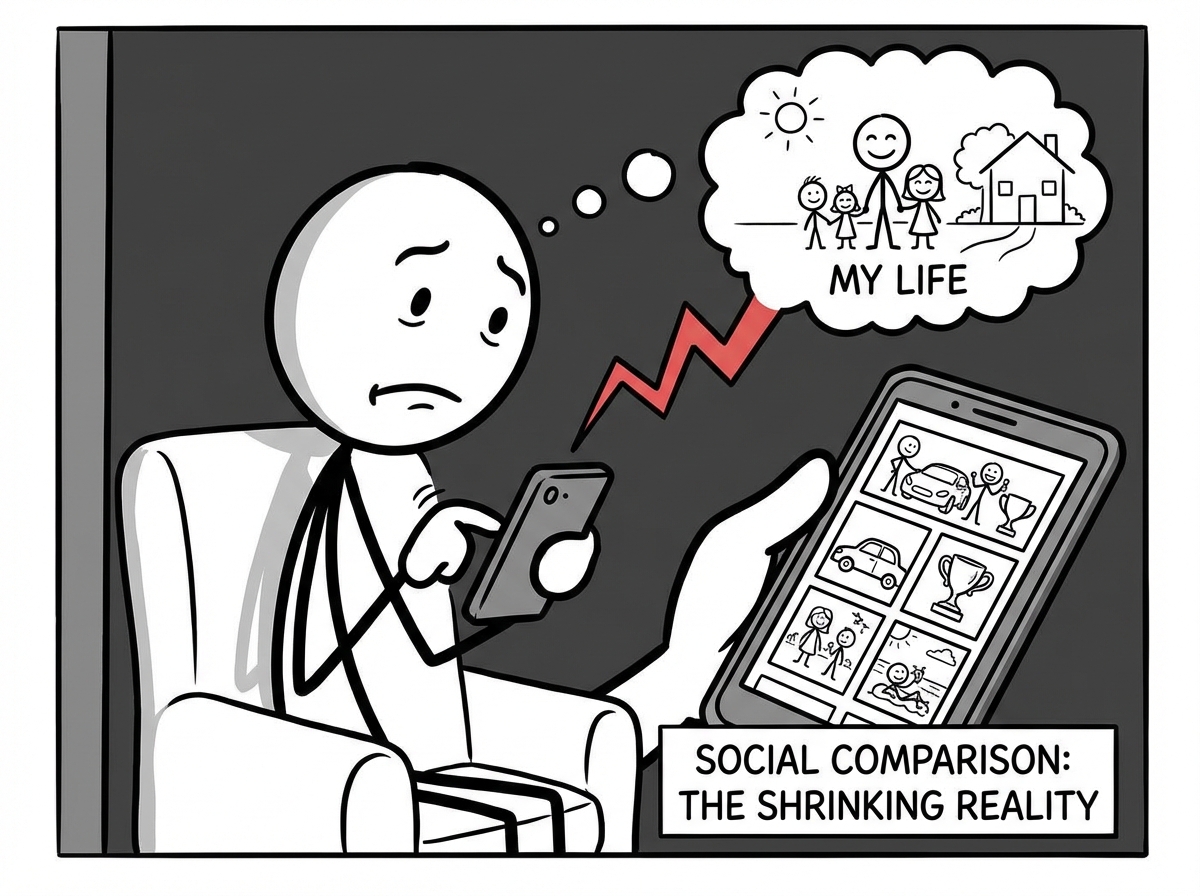
You did not decide to start comparing yourself to other people. Your brain did it for you. Social comparison theory, first proposed by Leon Festinger in 1954, argues that humans have a hardwired drive to evaluate their own abilities and opinions by measuring them against others. It was useful when your reference group was a handful of people in your village. It is significantly less useful when your reference group is every person on the internet who appears to be thriving while you are eating cereal for dinner. The problem is not that comparison exists -- it is that it lies to you. Upward comparison, where you measure yourself against people who seem to be doing better, rarely motivates. Research shows it mostly just makes you feel inadequate, anxious, and behind. And downward comparison, where you feel better by looking at someone worse off, provides only a fragile, guilt-laced relief that evaporates quickly. Social media has supercharged both directions. You are not comparing yourself to real people living real lives -- you are comparing your unedited behind-the-scenes footage to someone else's carefully produced trailer. The result is a distorted sense of where you stand that has almost no relationship to reality. What makes social comparison particularly corrosive is how invisible it is. You do not notice you are doing it. You just suddenly feel worse about your apartment, your career, your relationship, your body -- without connecting it to the fifteen minutes you just spent scrolling. Recognizing the comparison reflex is not about eliminating it. It is about catching it in the act and asking yourself: am I measuring my life, or am I measuring my life against someone else's performance?
You are not falling behind -- you are comparing your unedited life to someone else's carefully curated performance.