The Tank That Ran Dry by Tuesday
A person starts Monday with a full willpower tank, white-knuckling through every temptation, until the tank runs empty by Tuesday afternoon and they wonder why they cannot keep anything going.

Willpower is not a character trait -- it is a depletable resource, and relying on it is a strategy designed to fail.
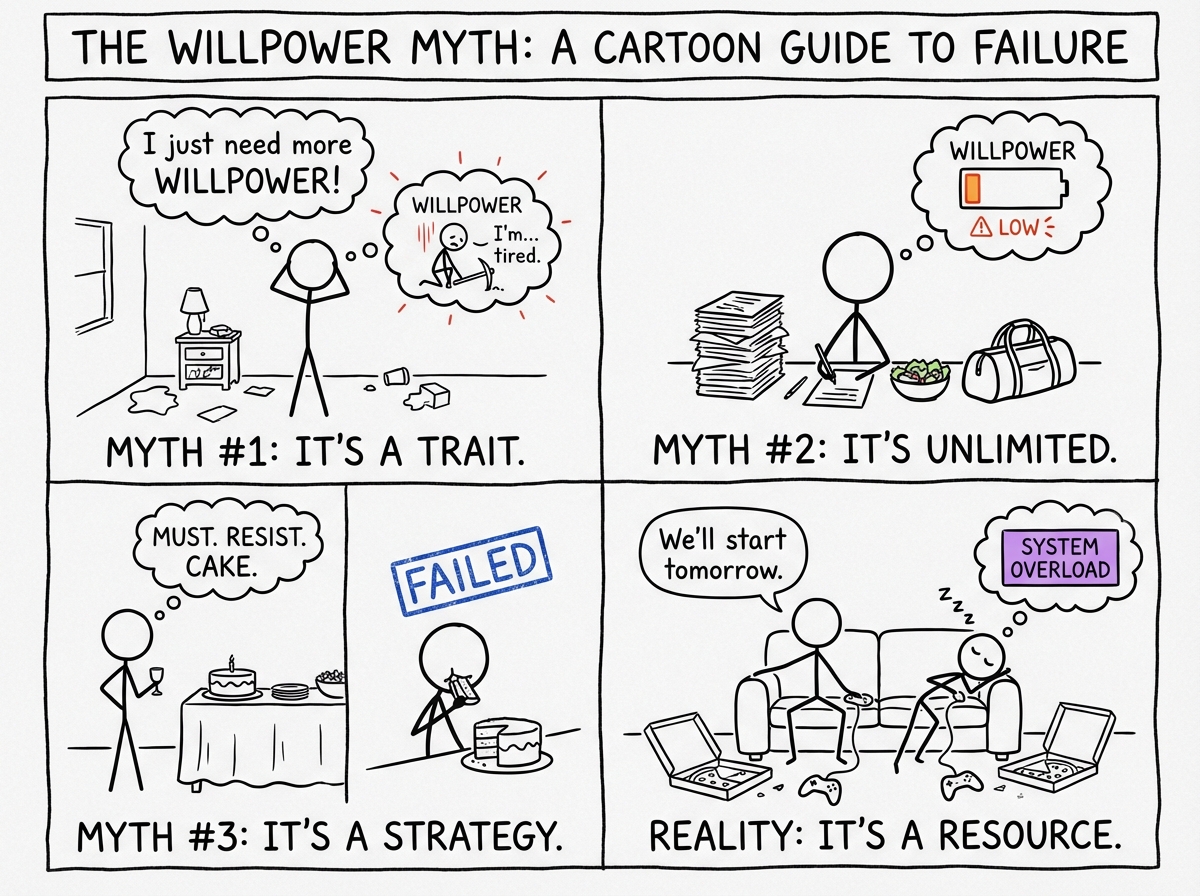
For decades, willpower was treated as the master key to behavior change: if you failed, you simply did not want it enough. Roy Baumeister's ego depletion research challenged this narrative by showing that self-control operates like a muscle that fatigues with use -- every decision, every resisted temptation, every forced smile at a coworker draws from the same limited pool. By afternoon, the tank is running low, and the cookie on the counter wins. While the replication crisis has complicated Baumeister's original findings, the broader insight holds: relying on moment-to-moment willpower as your primary change strategy is setting yourself up for predictable failure. Wendy Wood's research on automaticity reveals that people who appear to have extraordinary self-control are not actually resisting more temptations -- they have structured their lives so fewer temptations arise. They are not white-knuckling through the day; they have removed the need to. This reframe matters enormously because it shifts the locus of change from moral character to environmental design. You are not weak for running out of willpower at 4 PM. You are human. The question is not how to build a bigger tank but how to stop draining it on things that a better system could handle automatically.
People with great self-control are not resisting more -- they have designed their lives so there is less to resist.