
Losing Yourself in Someone Else
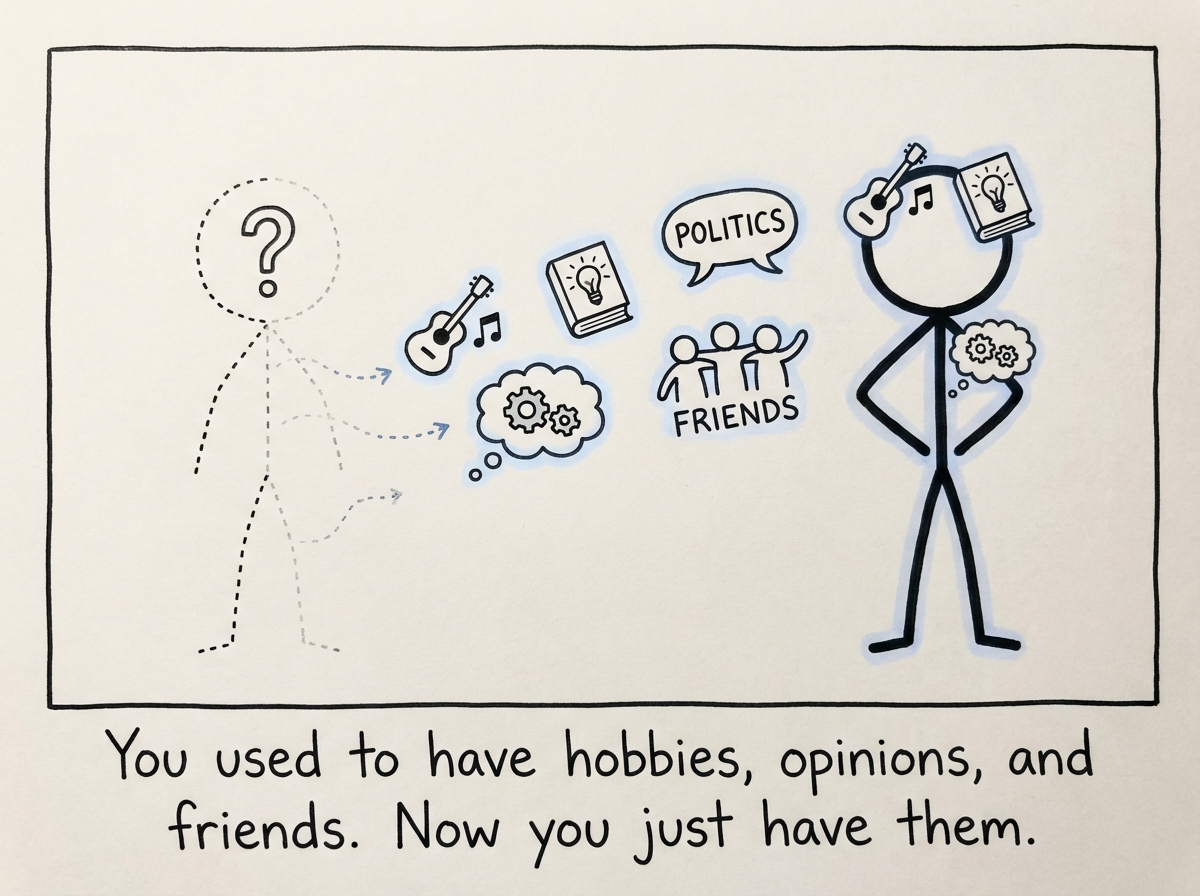
A person gradually loses their own identity -- hobbies, friends, opinions, goals -- as they become completely absorbed into another person's world.
Explanation
It happens so gradually you barely notice. First you start adopting their taste in music. Then you spend less time with your own friends because you are always with theirs. You stop doing the hobbies you used to love because your schedule revolves around them. Your opinions start to mirror theirs. Your goals become their goals. One day you wake up and realize you do not know who you are outside of this relationship -- and the thought of being alone is terrifying because you are not sure there is a 'you' left to be alone with. Codependent identity loss is one of the most insidious aspects of codependency because it feels like love. Society romanticizes the idea of 'becoming one' with a partner, but there is a critical difference between healthy interdependence and enmeshment. In healthy interdependence, two whole people share a life together. In enmeshment, one or both people disappear into the relationship and lose the ability to function independently. The identity loss is not a sign of deep love -- it is a sign that your sense of self was fragile to begin with, and the relationship provided a convenient structure to hide inside. Rebuilding identity after codependent loss requires intentional effort. Start small: What music do you actually like? What would you do on a Saturday if no one else's preferences mattered? What opinions do you hold that differ from your partner's? These questions might feel surprisingly difficult to answer -- and that difficulty is the proof that the work is necessary. Your identity should be something you bring to a relationship, not something you borrow from one.
Key Takeaway
If you can not describe yourself without mentioning another person, you did not lose yourself in love -- you gave yourself away.
A stick figure looking in the mirror and seeing only their partner's reflection, pausing with the thought: 'Where did I go?'
The figure pulling out an old hobby -- a guitar, a sketchbook, running shoes -- dusting it off with a tentative expression
The figure spending an evening with their own friends, laughing, while their partner is somewhere else doing their own thing
The figure looking in the mirror again, this time seeing their own face, interests, and identity clearly reflected back