The Smoke Detector That Will Not Stop
A person's internal smoke detector blaring at full volume in a perfectly safe room -- because it was installed during a fire and never recalibrated.

Living on permanent high alert long after the danger has passed.
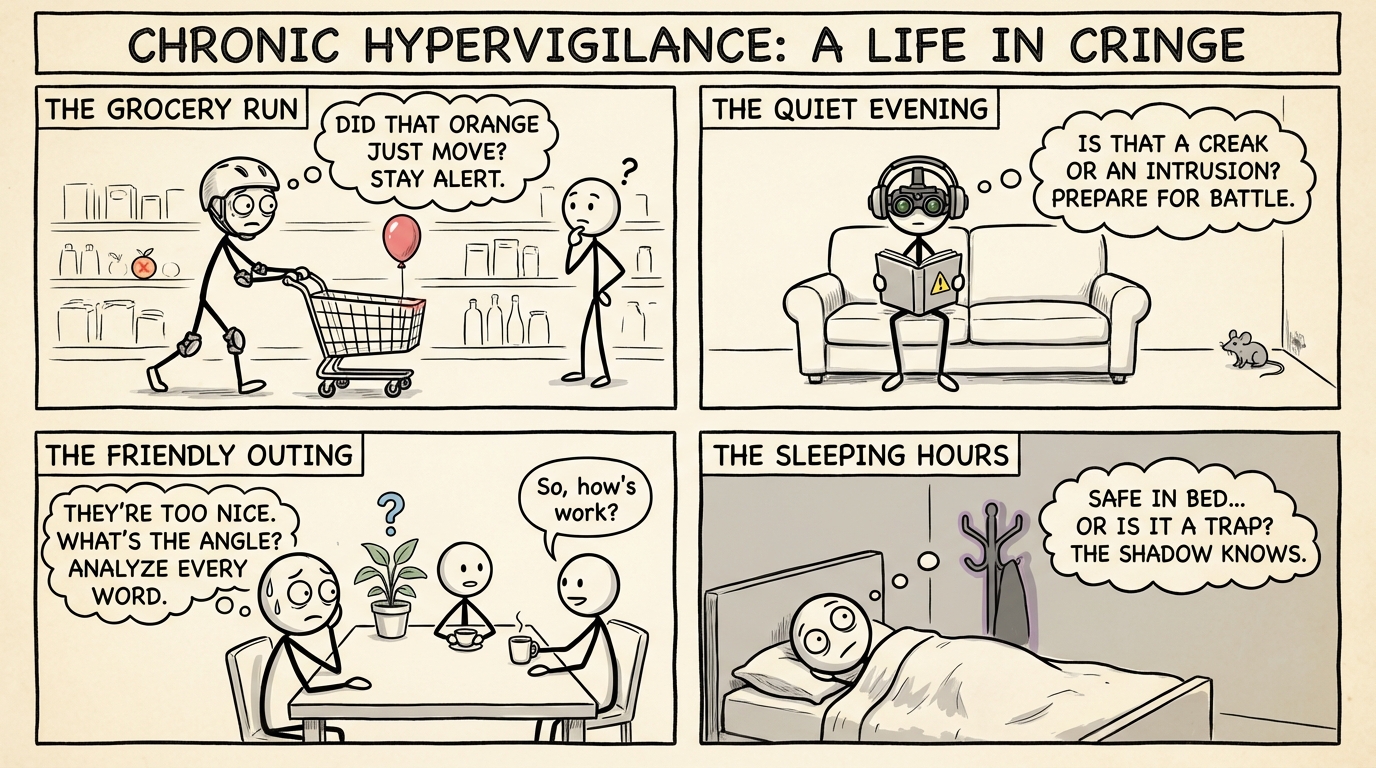
Chronic hypervigilance is a state of heightened sensory sensitivity and constant scanning for threats -- even when you are objectively safe. It is your nervous system stuck in 'on' mode, treating every unexpected sound, ambiguous facial expression, or minor change in someone's tone as a potential danger. This response made sense once. At some point in your life -- whether through trauma, an unpredictable home environment, bullying, or chronic stress -- your brain learned that letting your guard down was dangerous. So it stopped letting your guard down, ever. The amygdala, your brain's threat detection center, became overactive, while the prefrontal cortex -- responsible for rational assessment -- lost some of its ability to override the alarm. Bessel van der Kolk, in 'The Body Keeps the Score,' describes how trauma literally rewires the brain's alarm system, leaving it calibrated for a world that may no longer exist. Stephen Porges' Polyvagal Theory explains this as a nervous system stuck in sympathetic activation -- the fight-or-flight branch running the show long after the original threat has ended. The result is exhausting: you cannot relax in social situations, you read danger into neutral events, you sleep lightly if at all, and your body carries tension like a permanent second skin. Healing hypervigilance is not about ignoring danger -- it is about teaching your nervous system to distinguish between then and now, so it can finally stand down when standing down is safe.
You cannot think your way out of hypervigilance -- but you can slowly teach your nervous system to tell the difference between then and now.
A stick figure placing a hand on their chest, noticing their racing heartbeat, a thought bubble reading 'My alarm is going off again.'
A stick figure doing a grounding exercise, feet flat on the floor, naming five things they can see in the safe room around them.
A stick figure sitting with a therapist, practicing slow breathing, the smoke detector on their chest still present but the volume dial turning down slightly.
A stick figure making toast in a calm kitchen, a small puff of steam rising, the smoke detector staying quiet, the figure looking cautiously relieved.