Losing Yourself in Someone Else
A person gradually loses their own identity -- hobbies, friends, opinions, goals -- as they become completely absorbed into another person's world.

When helping others becomes a way to avoid helping yourself.
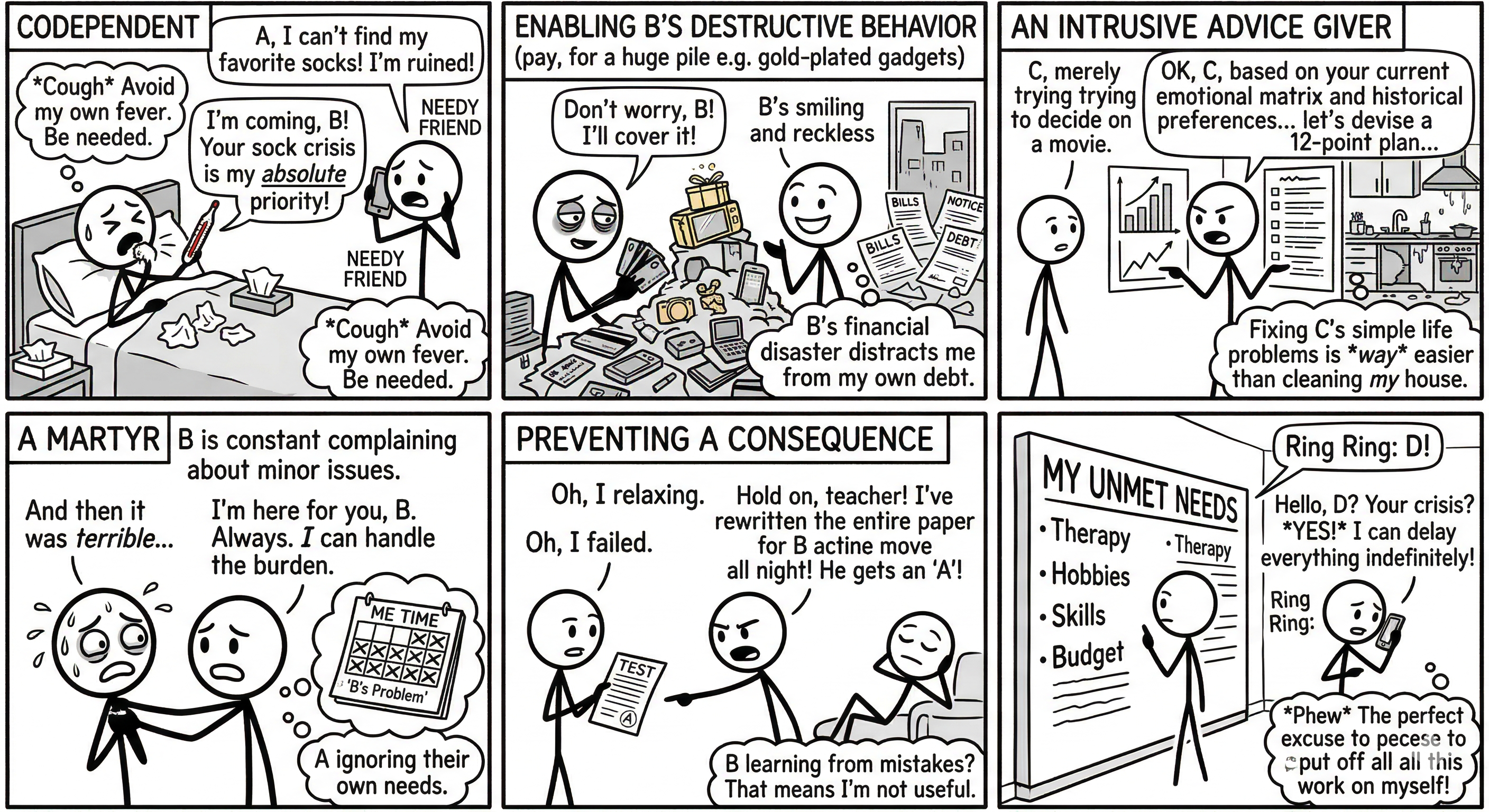
Codependency is a relational pattern in which your sense of identity, self-worth, and emotional stability become excessively dependent on another person. Originally identified in the context of addiction recovery, codependency has since been recognized as a broader pattern that shows up in all kinds of relationships. A codependent person often takes on the role of caretaker, fixer, or rescuer -- not purely out of generosity, but because being needed gives them a sense of purpose and worth. They may neglect their own needs, suppress their own emotions, and lose track of their own identity in the process. Codependency often pairs with poor boundaries: you say yes when you mean no, you prioritize others at your own expense, and you feel responsible for other people's feelings. Recovery from codependency involves learning to distinguish between genuine care for others and using caretaking as a way to manage your own anxiety and self-worth.
Healthy love means two whole people choosing each other -- not one person disappearing into the other's needs.
A stick figure pausing mid-rescue of someone else's crisis, noticing their own house is on fire behind them
The stick figure sitting with empty hands, feeling uncomfortable, while the other person solves their own problem nearby
The stick figure doing something just for themselves -- painting, running, reading -- while the other person handles their own life
Both stick figures standing side by side as complete people, connected but not merged, each with their own activities and interests
A person gradually loses their own identity -- hobbies, friends, opinions, goals -- as they become completely absorbed into another person's world.
A codependent person rushes to fix someone else's problems, neglecting their own life in the process, because being needed feels safer than addressing their own issues.