The Invisible Cage
A person lives inside a cage with no visible bars, where the walls are made of rules disguised as kindness, until they finally see the cage for what it is.

Abuse that does not leave bruises -- it leaves invisible walls that look like love from the outside.
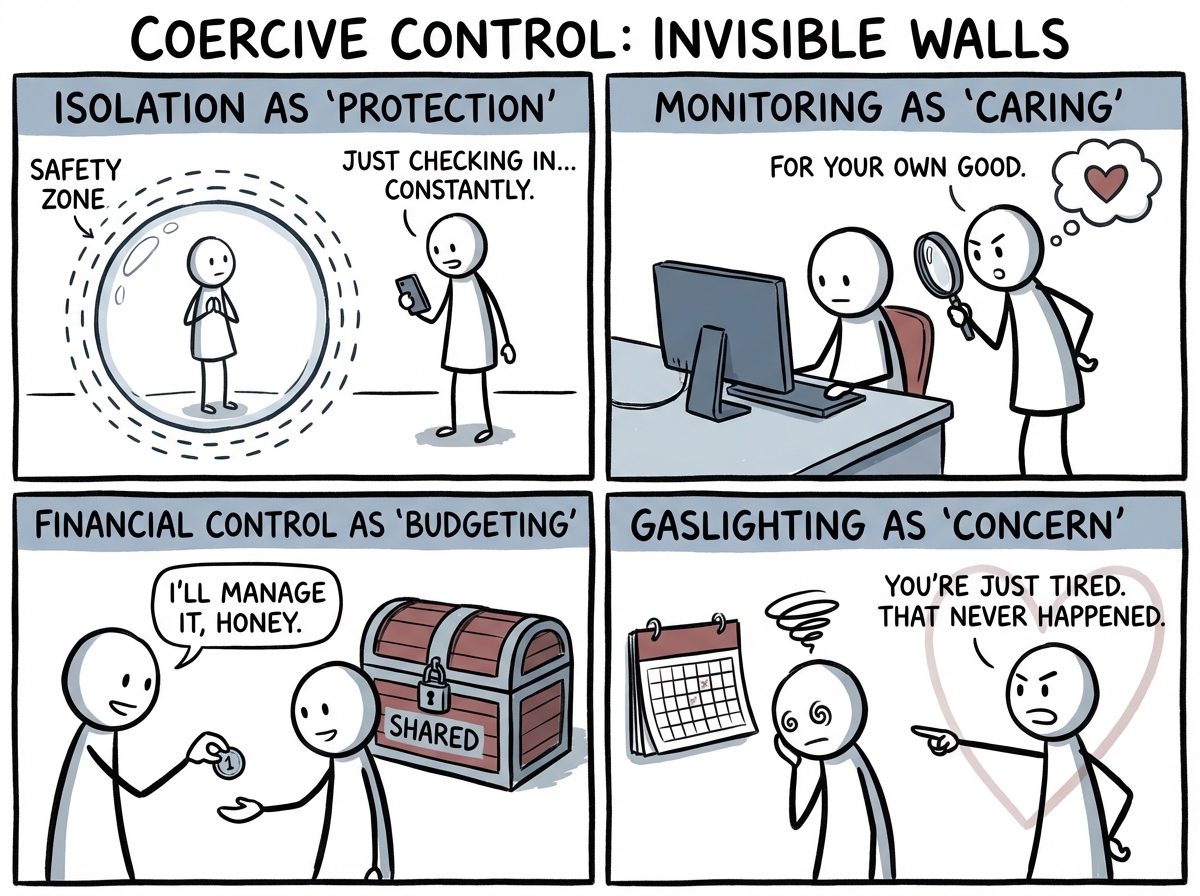
Coercive control is a pattern of domination in intimate relationships that operates through isolation, surveillance, microregulation of daily life, and the systematic erosion of autonomy -- all without necessarily involving physical violence. Sociologist Evan Stark, who coined the term, describes it as a 'liberty crime' rather than an assault crime, because the primary harm is the destruction of personhood rather than the body. The controller does not need to hit; they need to make the world so small that the victim cannot imagine leaving. This is accomplished through tactics that individually appear benign or even loving -- checking in constantly, managing finances 'for your own good,' discouraging friendships that 'are not good for you' -- but collectively form a cage. Research by the National Institute of Justice found that coercive control is a stronger predictor of intimate partner homicide than prior physical violence, underscoring how dangerous these seemingly subtle patterns can be. Victims often struggle to name what is happening because the abuse wears the language of care. There are no bruises to photograph, no single incident dramatic enough to justify leaving. The genius of coercive control is that it recruits the victim's own empathy and self-doubt as enforcement mechanisms, making the cage feel like a choice.
The most dangerous cage is the one built from words that sound like love -- because the prisoner blames themselves for wanting to leave.