The Brain's Late-Night Movie
A person's sleeping brain operates as a chaotic film director producing bizarre movies with zero budget and no coherent plot, then refuses to explain itself in the morning.

Why your brain writes strange movies every night.
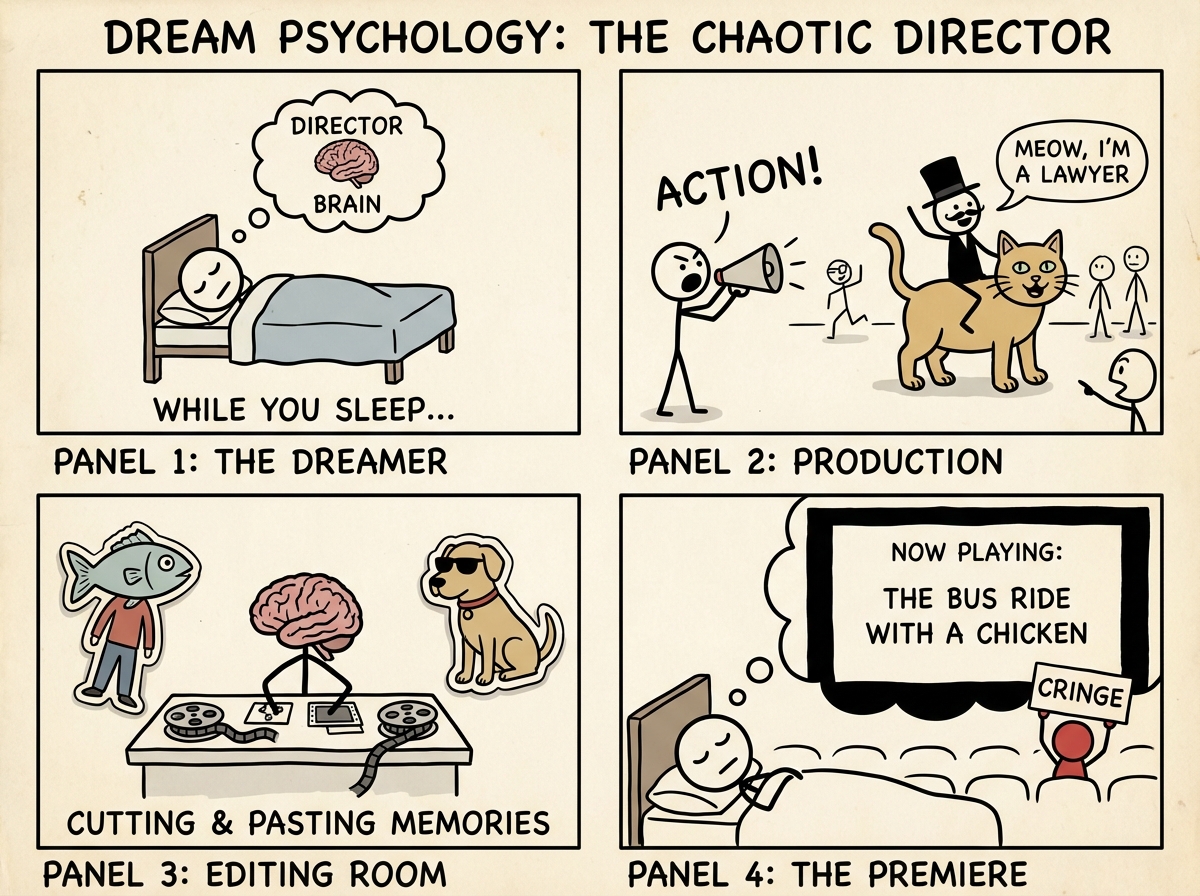
Dream psychology spans over a century of wildly different theories about why your sleeping brain generates vivid, bizarre, emotionally charged experiences every single night. Freud believed dreams were the disguised fulfillment of repressed wishes. Jung saw them as messages from the collective unconscious. Modern neuroscience suggests something less poetic but equally fascinating: dreams appear to play a critical role in memory consolidation, emotional regulation, and creative problem-solving. During REM sleep, your brain replays and reorganizes the day's experiences, strips away unnecessary emotional charge, and forges unexpected connections between ideas. The strangeness of dreams is not a bug -- it is the brain thinking associatively without the prefrontal cortex acting as editor. Your dreams are not prophecies or coded messages, but they are far from meaningless noise.
Dreams are not random noise or secret prophecies -- they are your brain thinking without a filter, processing what your waking mind could not finish.