The Feelings Minimizer
A person shares a genuine emotion only to have it systematically shrunk by well-meaning but invalidating responses like 'at least' and 'you should not feel that way.'

What happens when your feelings are dismissed, minimized, or treated as wrong.
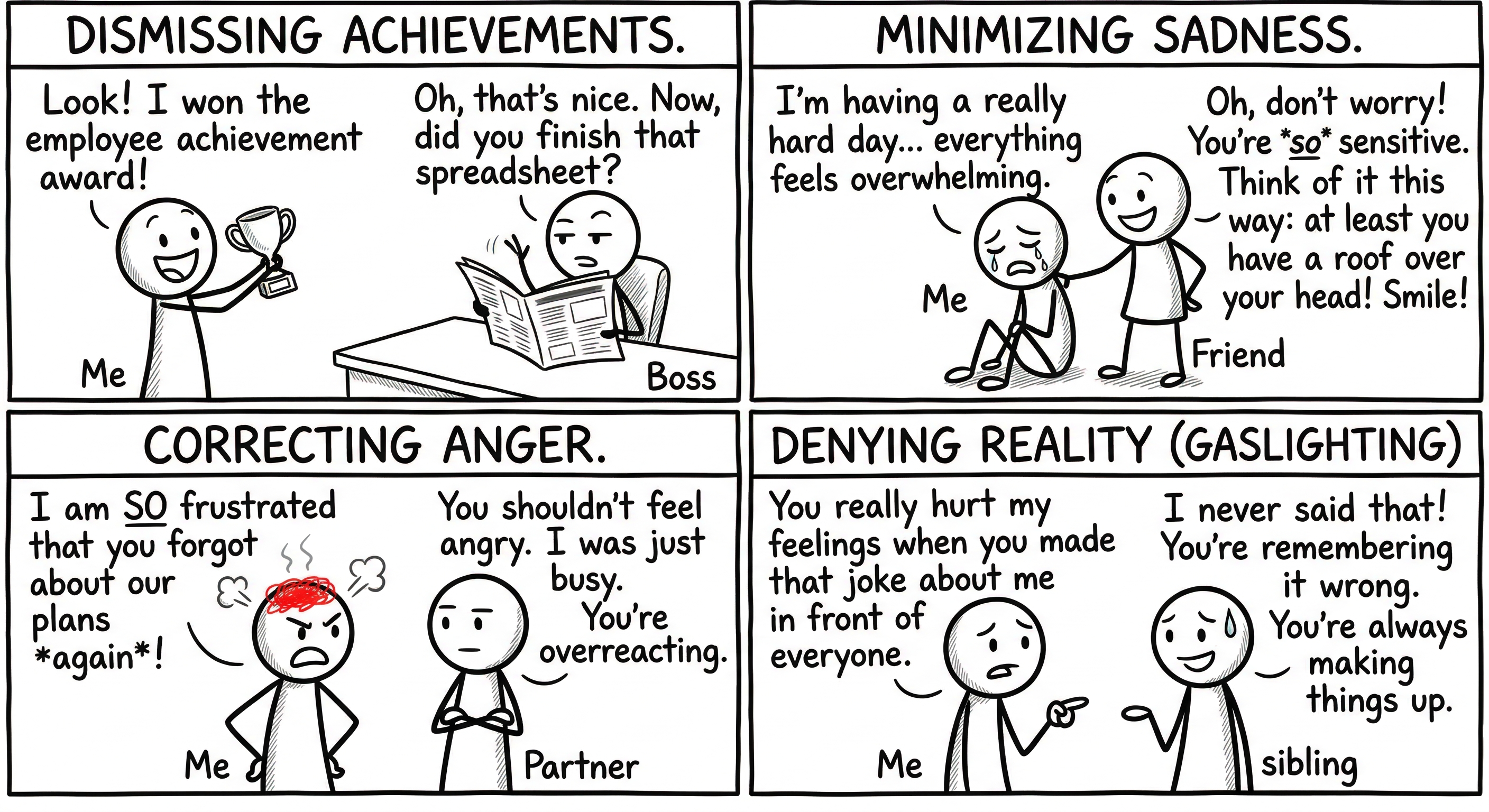
Emotional invalidation occurs when someone dismisses, ignores, or judges your emotional experience. It can sound like 'You are overreacting,' 'It is not that big of a deal,' 'You should not feel that way,' or even silence when you need acknowledgment. Invalidation does not always come from bad intentions -- sometimes people invalidate because they are uncomfortable with emotions, were raised in invalidating environments themselves, or genuinely believe they are helping by 'putting things in perspective.' But the impact is the same: over time, you learn to distrust your own feelings. You start questioning whether your emotions are legitimate, whether you have the right to feel hurt, or whether you are just too sensitive. Chronic invalidation -- especially in childhood -- is a core factor in many mental health challenges, including anxiety, depression, and difficulty regulating emotions. Validation does not mean agreeing with someone; it means communicating that their emotional experience makes sense and matters.
Validation does not mean agreeing -- it means communicating that what someone feels is real and makes sense.
A stick figure sharing something painful while the listener pauses, resisting the urge to say 'at least' or 'but'
The listener choosing to say 'That sounds really hard' instead of 'It could be worse,' with a warm and present expression
The first figure visibly relaxing, their feelings no longer shrinking, as the listener simply sits with them in the moment
Both figures talking openly, one saying 'Thank you for just listening' while the other nods, no advice given