Your Emotional Regulation Toolkit
A practical, visual guide to grounding techniques and coping strategies you can use when emotions start to overwhelm you.

How to ride the wave of big emotions without being swept away by them.
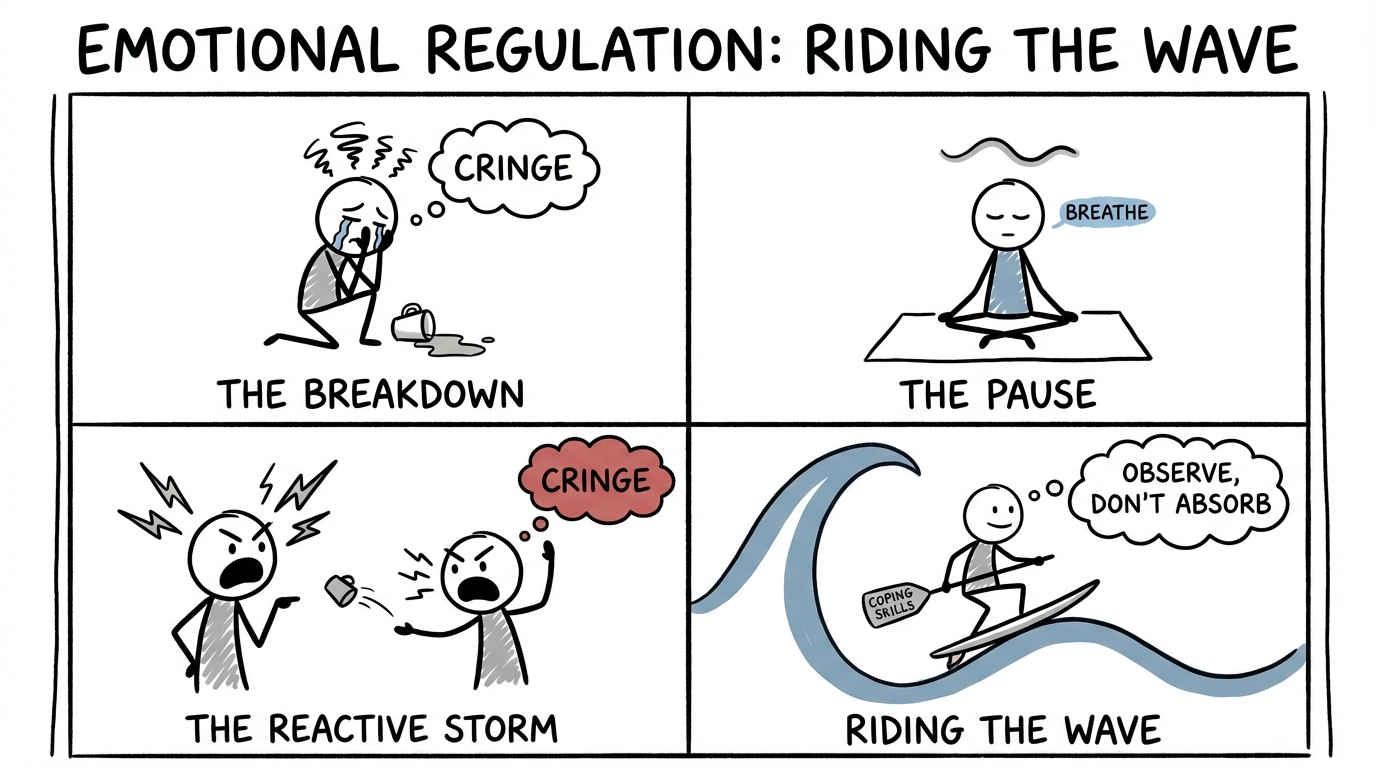
Emotional regulation refers to your ability to manage and respond to emotional experiences in a healthy, adaptive way. It does not mean suppressing your feelings or pretending everything is fine. It means developing the capacity to experience strong emotions -- anger, sadness, fear, excitement -- without being controlled by them. Dr. Dan Siegel's concept of the 'window of tolerance' describes the zone in which you can function effectively: too much arousal and you become overwhelmed (hyperarousal), too little and you shut down (hypoarousal). The goal of emotional regulation is to widen that window over time. Techniques like grounding, deep breathing, naming your emotions, and creating space between stimulus and response all help. This is not about becoming a robot -- it is about giving yourself the freedom to feel deeply while still making choices you are proud of.
Emotional regulation is not about suppressing feelings -- it is about widening your window of tolerance so you can feel deeply and still choose wisely.
A stick figure feeling a strong emotion rising -- shown as a wave -- and instead of fighting it or drowning in it, planting their feet and preparing to ride it
The stick figure using a grounding tool -- hands under cold water -- while the emotional wave crests around them but does not pull them under
The stick figure riding the wave, still feeling the emotion but maintaining their ability to think and choose their response
The wave passing, the stick figure standing steady, with their window of tolerance visibly a little wider than before
A practical, visual guide to grounding techniques and coping strategies you can use when emotions start to overwhelm you.
A visual explanation of Dr. Dan Siegel's 'window of tolerance' concept -- the emotional zone where you can function, and what happens when you go above or below it.
A person becomes completely overwhelmed by emotions during an argument, losing the ability to think clearly or communicate effectively.