The Kitchen That Made You Eat Chips
A person's kitchen is designed so that chips are at eye level and fruit is hidden in a drawer, then they redesign it and wonder why behavior change suddenly got easier.

You do not rise to the level of your goals -- you fall to the level of your environment.
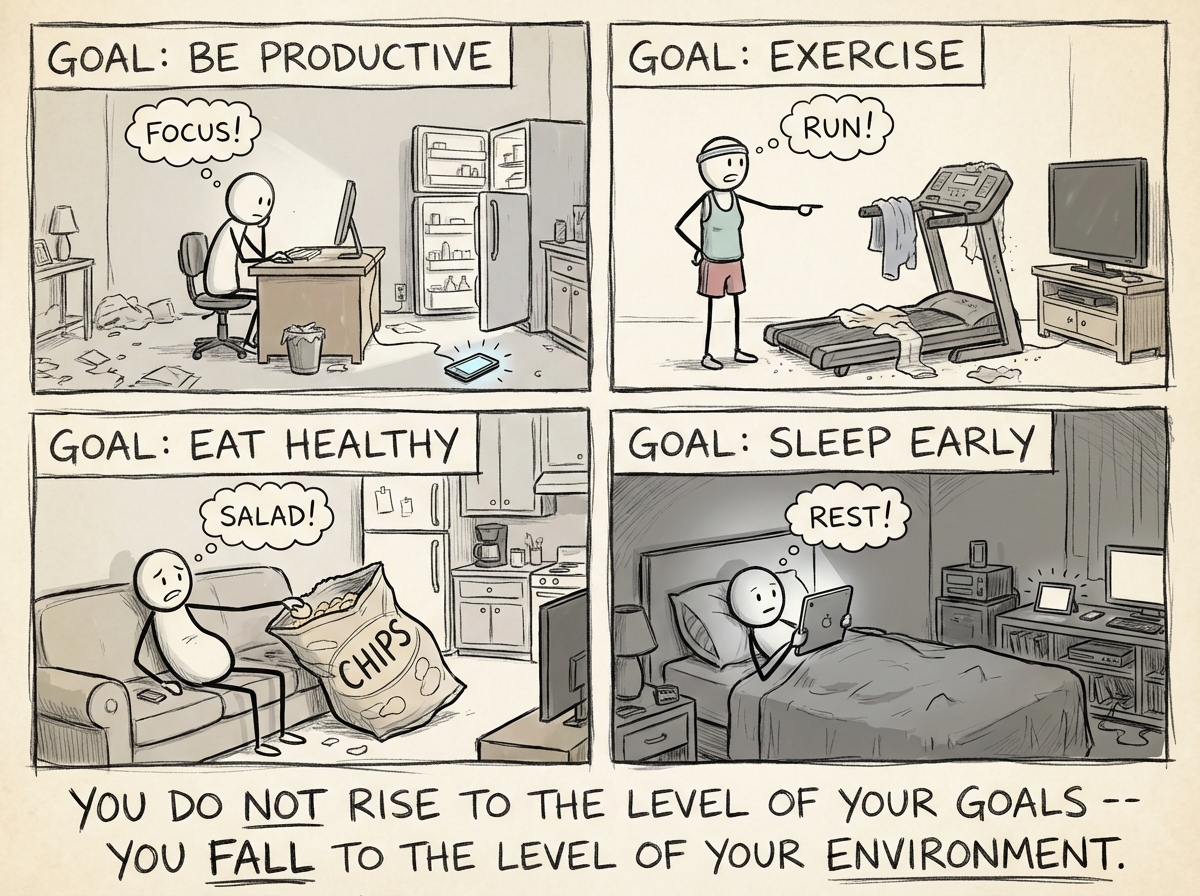
Environment design is the practice of structuring your physical and digital surroundings to make desired behaviors easier and undesired behaviors harder. It is one of the most underused strategies in behavior change because it feels too simple to be powerful -- but the research says otherwise. Kurt Lewin, the father of social psychology, argued that behavior is a function of the person and their environment, not the person alone. Brian Wansink's food psychology lab at Cornell demonstrated this dramatically: people ate 45 percent more candy when the dish was on their desk versus six feet away. The effort difference was trivial. The behavioral difference was enormous. James Clear calls this 'friction' -- every additional step between you and a behavior reduces the likelihood of that behavior occurring. Want to eat healthier? Put fruit on the counter and chips in the basement. Want to scroll less? Move your phone to another room at night. Wendy Wood's research on automaticity confirms that roughly 43 percent of daily behavior is performed habitually in the same context, meaning the environment is not just influencing your choices -- it is making many of them for you. The most effective behavior change does not require more discipline. It requires a redesigned space that makes the right choice the default choice.
The most powerful behavior change strategy is not more discipline -- it is a room where the right choice is the easiest one.