The Safe Side of Never Trying
A person builds an elaborate fortress of excuses and backup plans to avoid ever attempting the thing they want most, because not trying feels safer than trying and failing.

When not trying becomes the safest option -- because at least you cannot fail at something you never attempted.
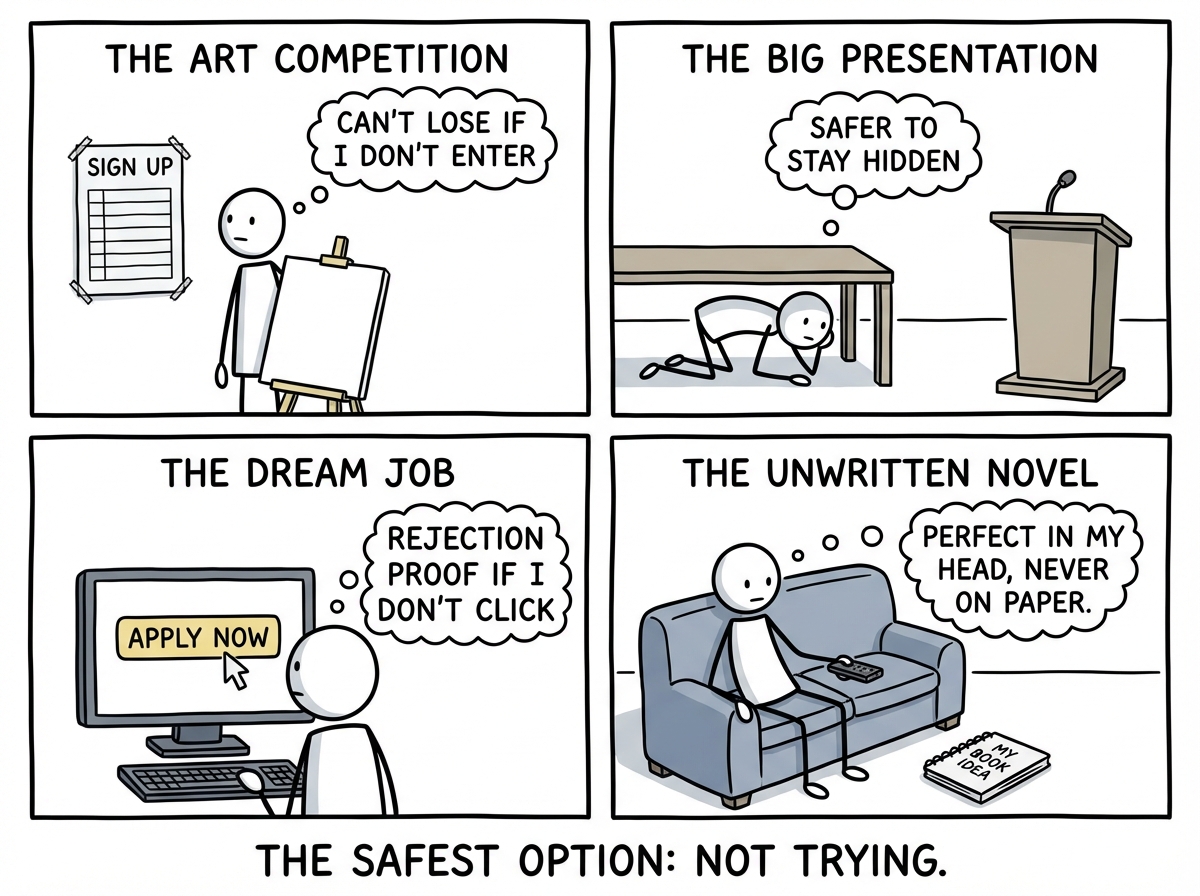
Fear of failure, known in clinical literature as atychiphobia, is the paralyzing avoidance of any situation where the outcome is uncertain -- not because you lack ability, but because the emotional cost of falling short feels unsurvivable. Psychologist Carol Dweck's research on fixed versus growth mindsets reveals the mechanism: people with a fixed mindset interpret failure as evidence of permanent inadequacy ('I failed, therefore I am a failure'), while those with a growth mindset treat it as information ('I failed, therefore I learned something'). When failure becomes an identity verdict rather than a data point, the rational response is to stop trying entirely. The fear is rarely about the task itself -- it is about what failure would prove about you. Martin Covington's self-worth theory of motivation explains that many people equate their value as a person with their ability to perform, which means every attempt becomes an existential referendum. This produces elaborate avoidance strategies: procrastination, over-preparation, setting goals so low they cannot possibly be missed, or never committing fully so you can always say you were not really trying. The tragedy of fear of failure is not that it prevents you from succeeding -- it is that it prevents you from starting. You build a life around the perimeter of risk, and from the outside it looks safe, even comfortable. But inside that perimeter is a person who has never discovered what they are actually capable of, because they never gave themselves the chance to find out.
The safest life is not the one where you never fail -- it is the one where failure cannot erase your worth.