The B-Plus That Changed Everything
A person submits something imperfect for the first time and braces for the world to end, but nothing happens, and they discover that good enough was enough all along.

The radical discovery that imperfect work, submitted, is infinitely more valuable than perfect work that never exists.
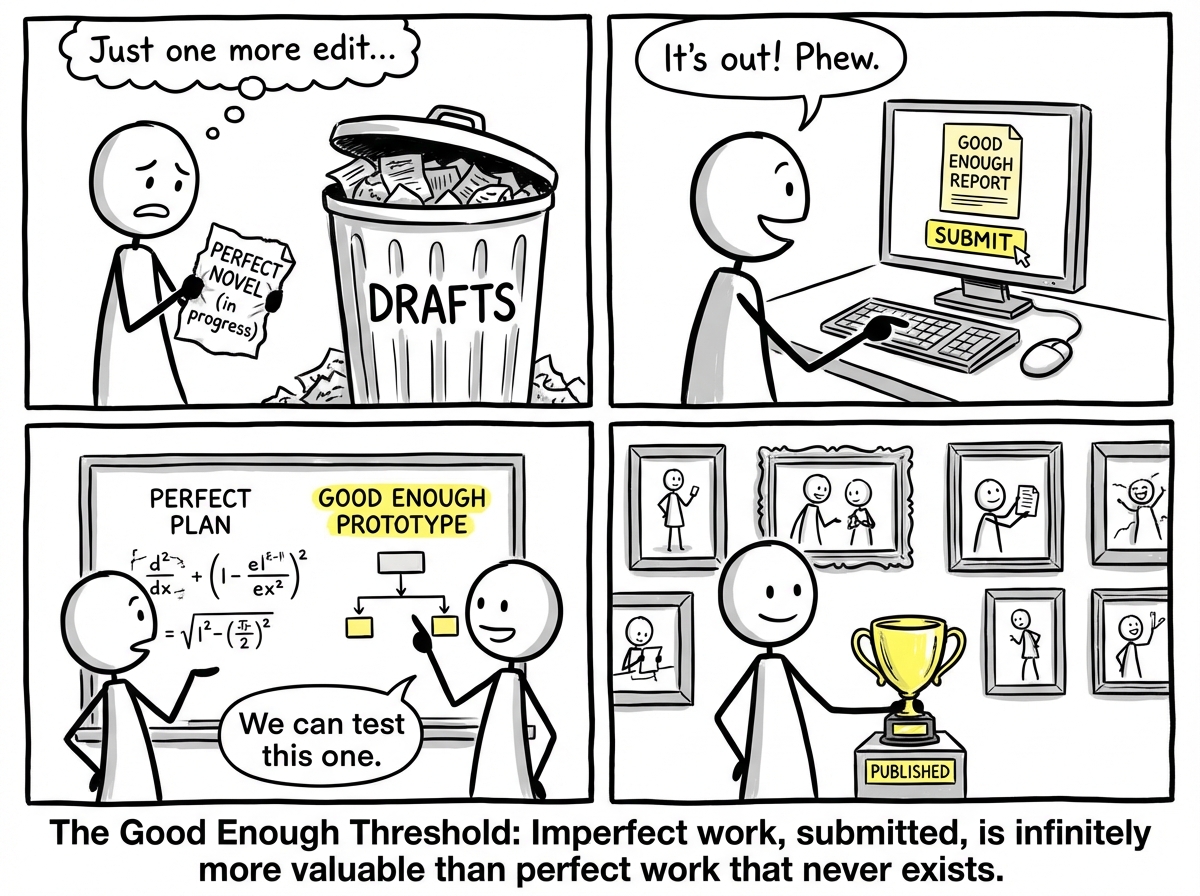
The good enough threshold is the psychological principle that optimal outcomes often come not from maximizing perfection, but from accepting a sufficient level of quality and moving forward. The concept draws from Herbert Simon's theory of satisficing -- the idea that in a world of limited time, energy, and information, seeking the 'good enough' option is often more rational and more effective than seeking the best possible option. Psychologist Barry Schwartz expanded on this in 'The Paradox of Choice,' demonstrating that maximizers (people who must find the absolute best) report significantly lower satisfaction, more regret, and more depression than satisficers (people who accept 'good enough'), even when maximizers objectively achieve better outcomes. For perfectionists, the good enough threshold is not a compromise -- it is a revolution. It challenges the foundational belief that anything less than flawless is worthless, and replaces it with a radical proposition: done is better than perfect, submitted is better than polished into oblivion, and a B-plus that exists in the world has infinitely more impact than an A-plus that lives forever in your drafts folder. Donald Winnicott's concept of the 'good enough mother' applies here too -- the insight that perfection in caregiving is not only unnecessary but actually harmful, because children need to experience manageable imperfection to develop resilience. The same is true for your relationship with your own work. Learning to release something imperfect is not lowering your standards -- it is raising your understanding of what standards are actually for.
Good enough is not settling -- it is the doorway through which your work actually enters the world.