The Human Blue Screen
A person who has completely frozen mid-task, displaying a human version of the computer blue screen of death.

When your body's answer to overwhelm is total shutdown.
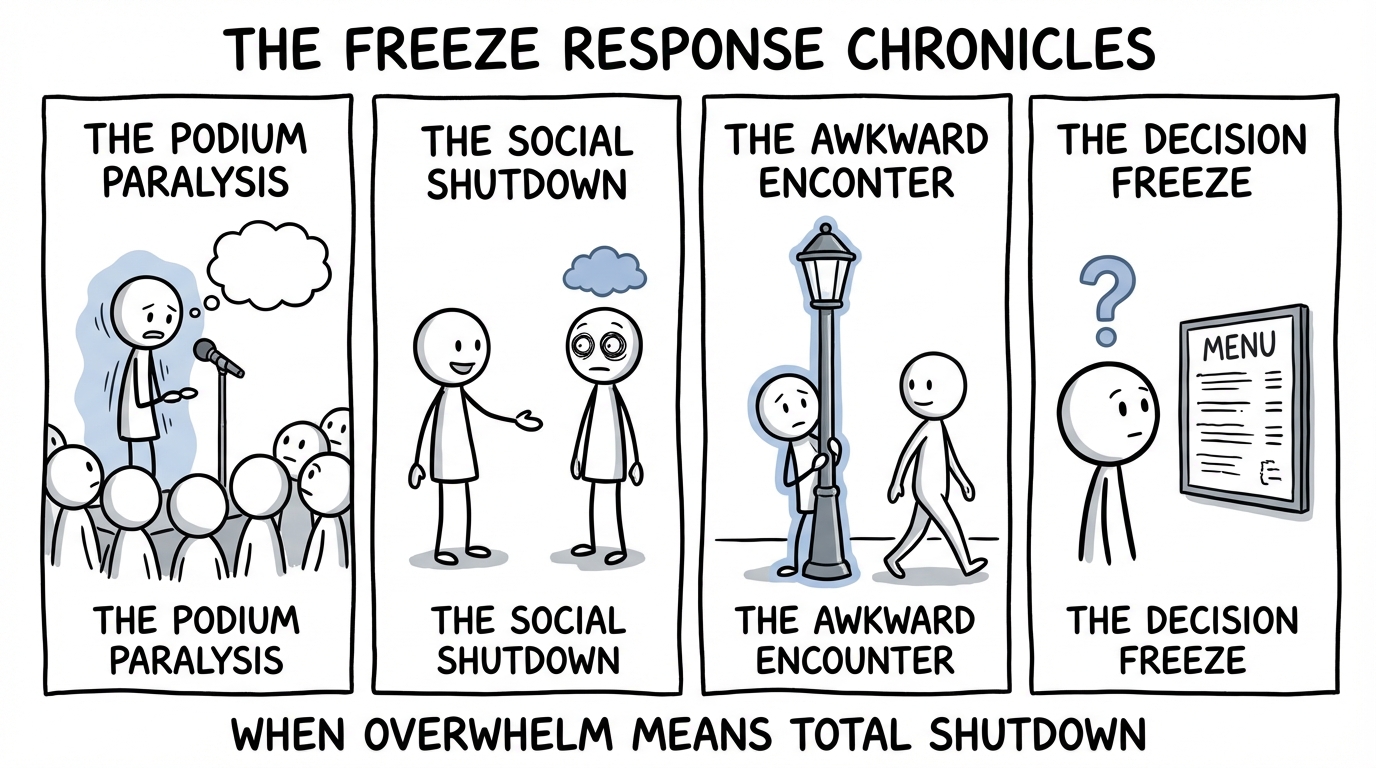
The freeze response is the nervous system's least understood survival strategy -- and for those who experience it, often the most confusing. While most people are familiar with fight or flight, freeze is the third option: a state of immobilization that occurs when the brain determines that neither fighting nor fleeing will work. It is governed by the dorsal vagal branch of the parasympathetic nervous system, as described in Stephen Porges' Polyvagal Theory. In nature, this looks like a deer going limp when caught by a predator -- playing dead as a last-ditch survival strategy. In humans, it looks like going blank during a difficult conversation, being unable to move or speak when overwhelmed, staring at a task for hours without starting it, or feeling disconnected from your own body during moments of high stress. Freeze is not laziness, weakness, or apathy -- it is a protective mechanism. Your nervous system has decided that the threat is too large, the options too few, and the safest course of action is to shut down and wait for the danger to pass. The problem is that in modern life, the 'danger' is often an email, a confrontation, a deadline, or an emotional trigger -- and the freeze response leaves you feeling paralyzed, ashamed, and stuck. Understanding the freeze response means recognizing it for what it is: not a character flaw, but a survival strategy. And the path out of freeze is not willpower -- it is gentle reactivation, safety, and reconnection to the body, one small movement at a time.
The path out of freeze is not willpower -- it is gentle reactivation, one small safe movement at a time.
A stick figure frozen at a desk, recognizing the blue screen state, a small thought bubble reading 'I am not broken. I am frozen.'
A stick figure wiggling their fingers slowly, then their toes, the blue screen beginning to flicker with tiny signs of life.
A stick figure standing up and pressing bare feet on the floor, feeling the texture, the blue screen fading to a gentle restart screen.
A stick figure at their desk again, moving slowly and gently, a sticky note reading 'One thing at a time,' the system back online at low power.