The Grief Without a Funeral
A person mourns a lost friendship but finds no ceremony, no card, and no cultural script for a grief that nobody treats as real.

The grief no one gives you a card for.
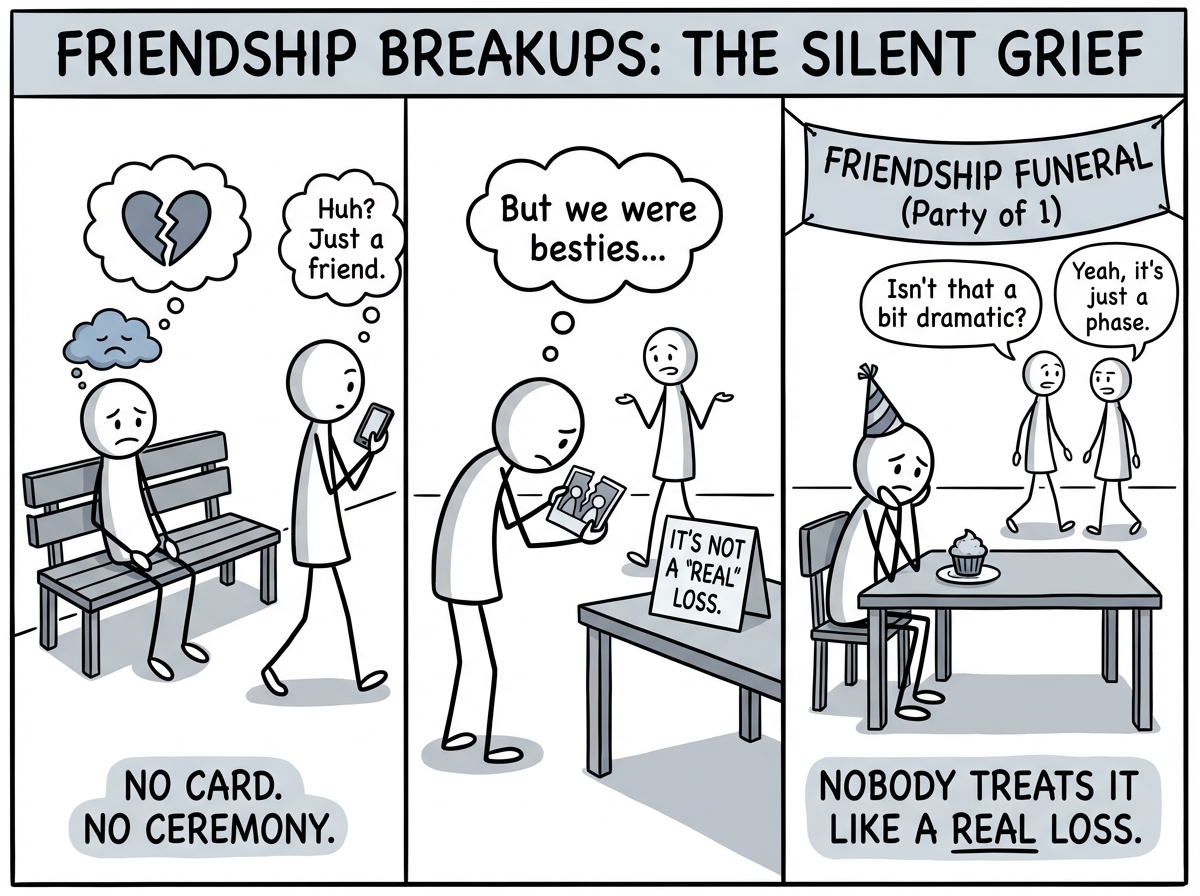
Romantic breakups get the playlist, the pint of ice cream, the sympathetic texts. Friendship breakups get silence. Maybe a vague sense of confusion. Maybe nothing at all. And yet research consistently shows that the end of a close friendship can be just as painful -- sometimes more painful -- than a romantic split. The difference is that there is no script for it. No one asks how you are holding up after your best friend slowly stopped texting back. There are no rituals, no closure conversations, no culturally approved grieving period. You are just expected to move on, as if losing someone who knew your most unfiltered self does not leave a crater. Psychologists point to the unique pain of friendship dissolution: friendships are voluntary, which means when one ends, it carries an implicit message that you were not worth choosing. Unlike romantic relationships, which have external pressures and formal structures, friendships run on pure mutual investment. When that investment is withdrawn, the rejection feels deeply personal. Friendship breakups also tend to be ambiguous -- there is often no single event, no dramatic fight, just a slow fade that leaves you wondering what you did wrong. This ambiguity makes the grief harder to process because there is nothing concrete to point to, nothing to argue with, nothing to resolve. Understanding friendship breakups matters because they are one of the most common and least discussed sources of adult grief. Naming the loss is the first step toward processing it -- because a relationship does not need a label to deserve mourning.
A relationship does not need a romantic label to deserve real grief when it ends.