The Guard Who Never Sleeps
A person posts a tiny guard version of themselves at the entrance to their heart, who interrogates every new person with a flashlight and clipboard, never letting anyone through because the last time was catastrophic.

The exhausting state of constant threat-scanning that develops when betrayal teaches your nervous system that safety is an illusion.
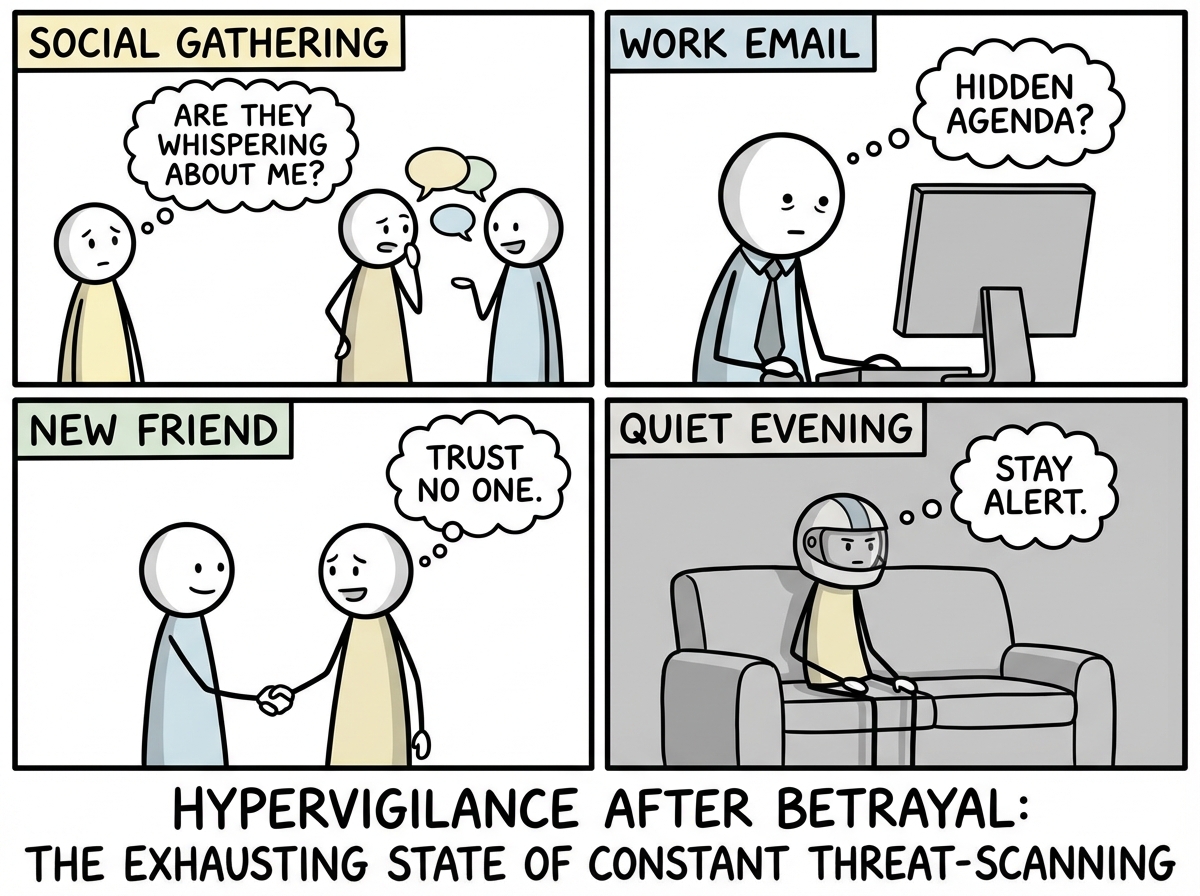
Hypervigilance after betrayal is your nervous system's attempt to make sure you are never blindsided again. After a significant betrayal -- infidelity, deception, institutional abuse -- the brain's threat detection system recalibrates. What was once background noise becomes a potential signal: a partner's phone buzzing, a slight change in tone, an unexplained absence. Neuroscientist Stephen Porges' Polyvagal Theory explains that betrayal shifts the autonomic nervous system into a chronic state of sympathetic activation, meaning the body stays in fight-or-flight mode even when the immediate danger has passed. The amygdala, the brain's alarm system, becomes hypersensitive, flagging ambiguous situations as threatening. This is not paranoia -- it is a trauma response. The person is not choosing to be suspicious; their nervous system is running a program that was installed by real danger. The cost is enormous: hypervigilance consumes cognitive resources, destroys sleep, erodes new relationships, and keeps the person trapped in the emotional landscape of the original betrayal. Recovery involves gradually teaching the nervous system that not every signal is a warning, which requires both safety in the present and processing of the past.
Hypervigilance after betrayal is not paranoia -- it is your nervous system doing exactly what it learned to do to keep you safe.