The Name Tag That Changed the Behavior
A person swaps their name tag from 'Person Trying to Run' to 'Runner' and finds the morning jog easier -- because behavior follows identity, not the other way around.

Lasting change does not start with what you do -- it starts with who you believe you are.
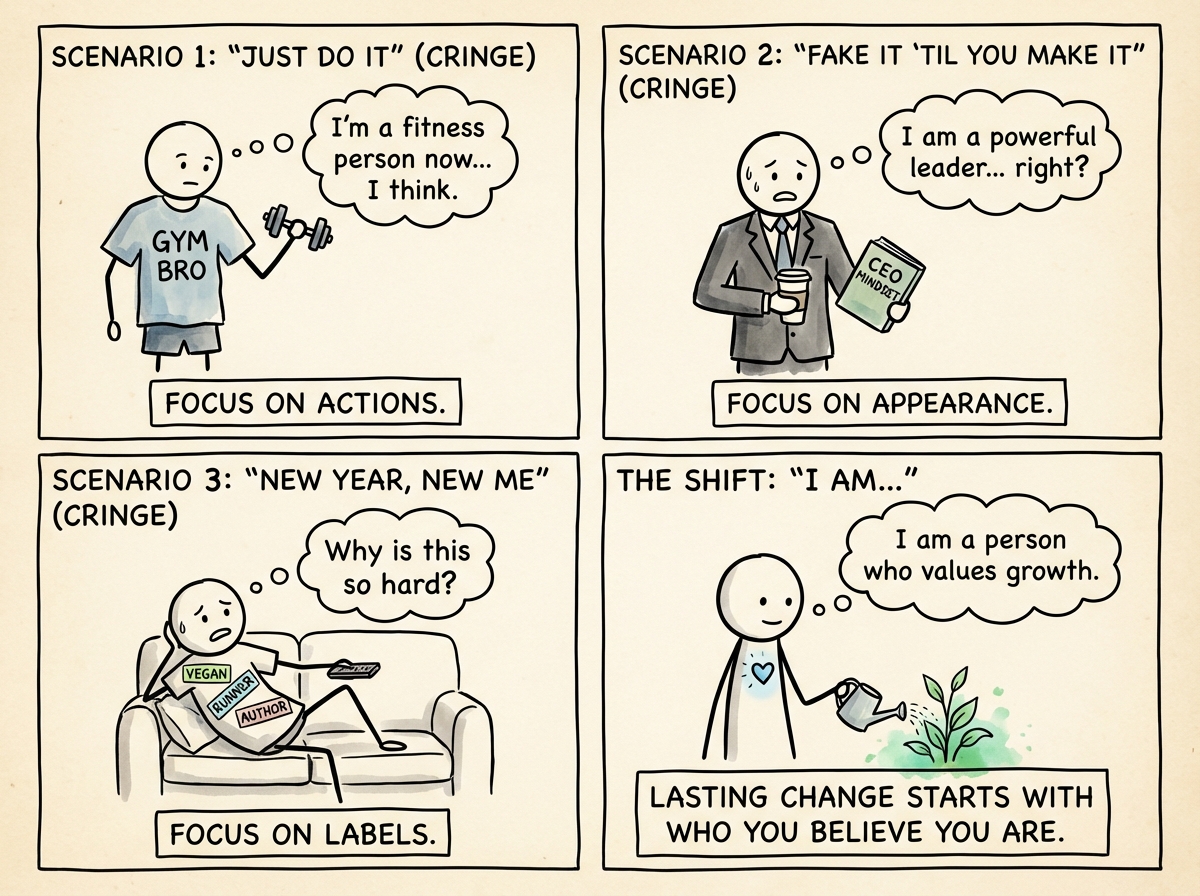
Most behavior change efforts begin with outcomes: lose ten pounds, run a marathon, quit smoking. James Clear, in Atomic Habits, argues this approach has the arrow backwards. Lasting change starts at the identity level -- not 'I want to run' but 'I am a runner.' This is not motivational fluff. It is grounded in self-perception theory, originally proposed by Daryl Bem, which shows that people infer their own attitudes and beliefs from observing their own behavior. When you cast a vote for a new identity -- even a small one, like choosing a salad once -- you begin to update your self-concept. Each repetition is evidence. Over time, the identity becomes self-reinforcing: runners run, writers write, healthy people choose health, not because they are disciplined but because the behavior is congruent with who they believe they are. The psychological power here is that identity creates internal motivation that does not require external reinforcement. Outcome-based goals produce compliance; identity-based goals produce alignment. Carol Dweck's growth mindset research supports this: people who see their traits as malleable are more likely to persist through setbacks because failure does not threaten their core self -- it is just part of the becoming. The shift from 'I am trying to' to 'I am someone who' is small linguistically but enormous psychologically.
Every action is a vote for the type of person you want to become -- and the votes add up faster than you think.