The Hovering Helicopter
A manager literally hovers over an employee's desk in a tiny helicopter, checking every keystroke, until the employee stops being able to type at all.

Hovering over someone's work is rarely about their competence -- it is almost always about your anxiety.
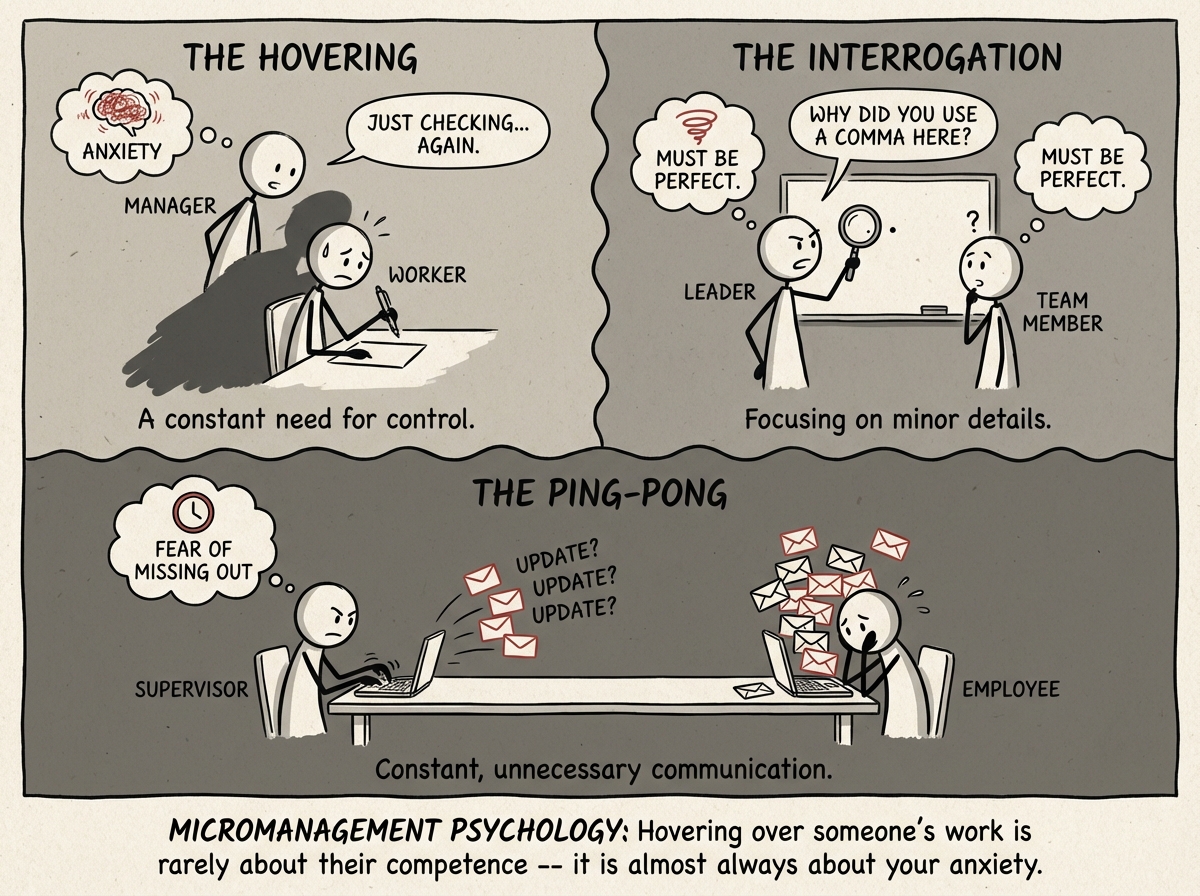
Micromanagement is the compulsive over-monitoring and over-controlling of subordinates' work, and while it is universally despised, it is rarely understood as what it actually is: an anxiety disorder wearing a management title. Research in organizational psychology consistently shows that micromanagement is driven not by employee incompetence but by the manager's own intolerance of uncertainty, perfectionism, and need for control. A study by the Journal of Experimental Psychology found that people who feel powerless in one domain compensate by exerting excessive control in another -- suggesting that the micromanaging boss may feel profoundly out of control in their own life. The downstream effects are devastating and well-documented. Teresa Amabile's research at Harvard Business School demonstrated that autonomy is one of the strongest predictors of creative output and intrinsic motivation, meaning micromanagement does not just annoy employees -- it systematically destroys their ability to do the work the manager claims to care about. The employee under constant surveillance begins to second-guess every decision, loses initiative, and eventually stops trying to think independently. The manager then interprets this learned passivity as evidence that more oversight is needed, creating a self-reinforcing cycle. The final irony is that micromanagement is a control strategy that produces the exact outcome it was designed to prevent: unreliable, dependent, disengaged workers who cannot function without being told what to do.
Micromanagement is not a management style -- it is an anxiety style that costs everyone their best work.