The Yes Machine
A person automatically says yes to every request until they are buried under other people's needs, having completely lost track of their own.

When keeping others happy becomes more important than being honest about your own needs.
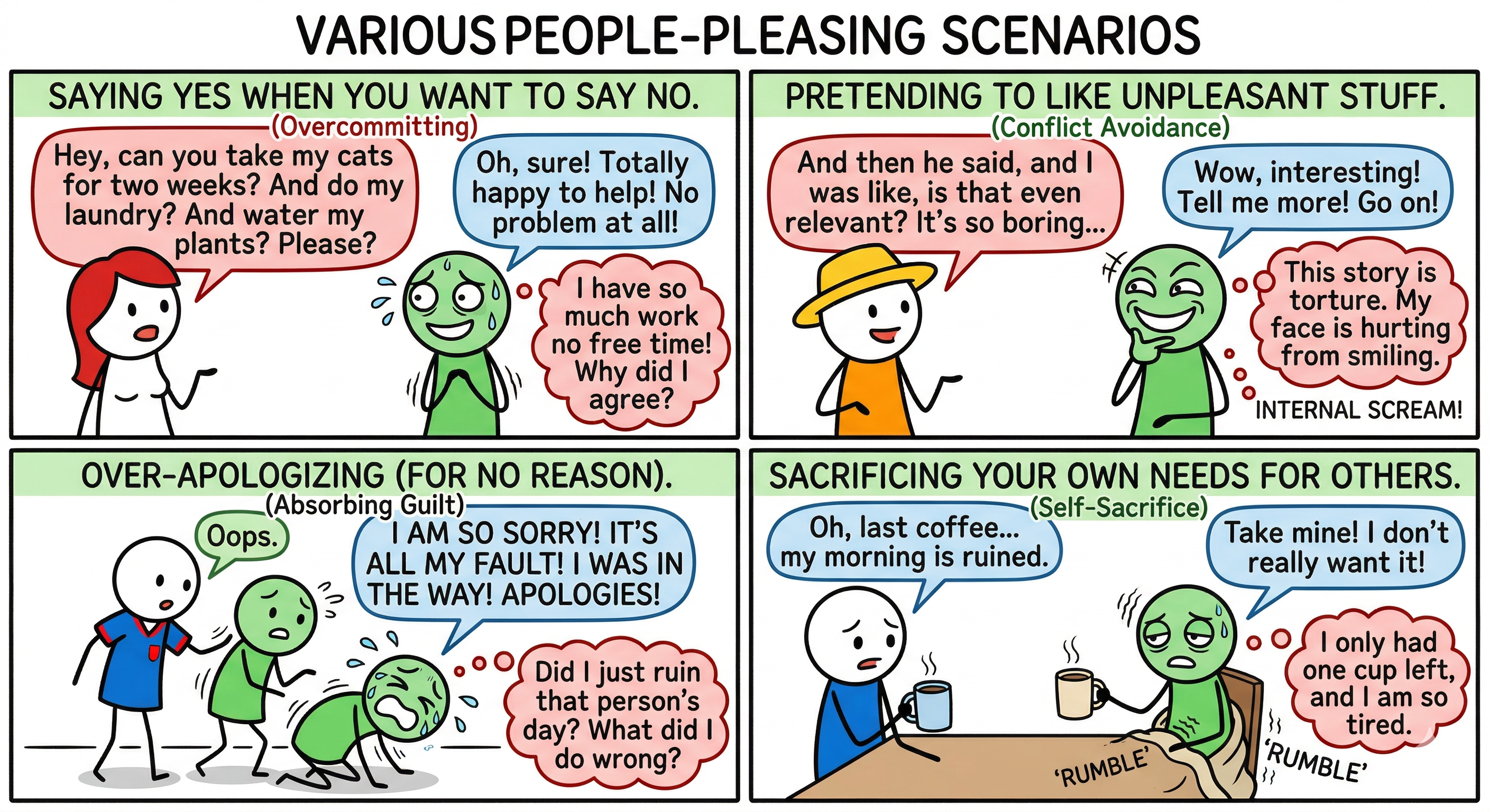
People-pleasing is the pattern of prioritizing other people's comfort, approval, and happiness at the expense of your own needs, boundaries, and authenticity. On the surface, it can look like kindness or generosity, but underneath it is usually driven by a fear of rejection, conflict, or abandonment. People-pleasers often struggle to say no, feel responsible for other people's emotions, and shape their behavior around what they think others want. The roots of people-pleasing frequently trace back to childhood -- growing up in an environment where love felt conditional on being 'good,' helpful, or invisible. Over time, people-pleasing becomes exhausting because you are constantly performing instead of being yourself. Recovery involves learning that your worth is not determined by how useful you are to others, and that honest relationships require you to show up as a whole person, not just the parts that make other people comfortable.
Your worth is not measured by how useful you are to others -- real relationships need the actual you, not a performance.
A stick figure about to say 'yes' automatically, catching themselves mid-word with a surprised look, hand over mouth
The stick figure saying 'Let me think about it' instead of immediately agreeing, with the other person looking completely fine
The stick figure saying 'I can not this weekend' calmly, feeling the guilt but holding steady, with a small bead of sweat
The stick figure doing something they chose for themselves, surrounded by fewer people but deeper smiles all around