The Unfinished Masterpiece
A person works on a project obsessively, never finishing or sharing it because it never meets their impossible standard -- revealing how perfectionism disguises fear of judgment as pursuit of excellence.

When the need to get everything right keeps you stuck, anxious, or ashamed.
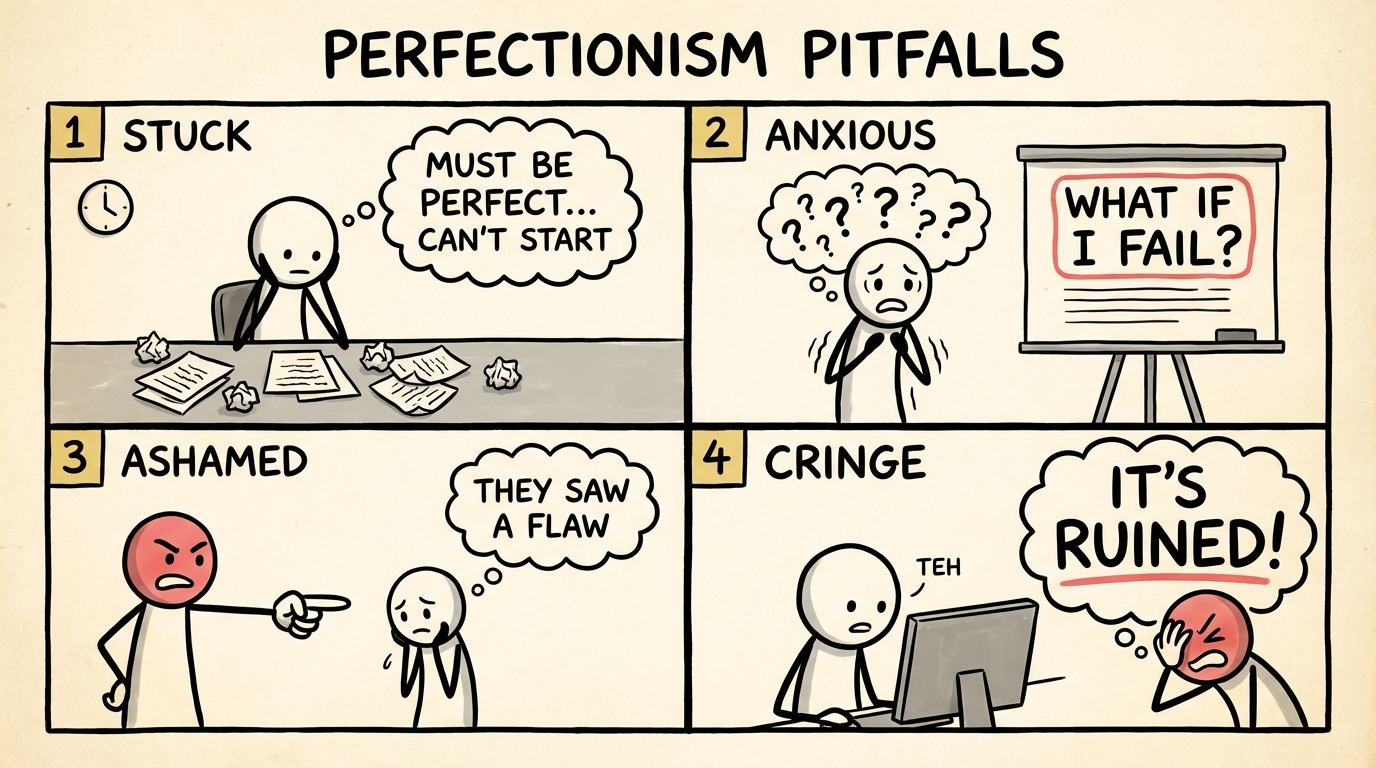
Perfectionism is often worn as a badge of honor, but beneath the surface it is usually driven by fear -- fear of failure, fear of judgment, fear of being seen as flawed. It is not the same as having high standards. High standards push you forward; perfectionism keeps you stuck. Perfectionists often procrastinate because starting feels overwhelming, abandon projects that are not turning out perfectly, or overwork themselves into exhaustion trying to eliminate every possible flaw. Psychologist Thomas Curran's research shows that perfectionism has been rising sharply across generations, fueled by social comparison, competitive environments, and the curated highlight reels of social media. There are three types: self-oriented (imposing unrealistic standards on yourself), other-oriented (demanding perfection from others), and socially prescribed (believing others expect perfection from you). All three are associated with anxiety, depression, burnout, and relationship difficulties. Recovery from perfectionism does not mean lowering your standards -- it means learning that your worth is not tied to flawless output.
Recovery from perfectionism means learning that something finished and imperfect is worth more than something perfect and invisible.
A stick figure staring at a ninety-five percent done painting, hearing the inner voice say 'It is not ready' and responding 'It does not have to be perfect to be valuable'
The stick figure taking a deep breath and signing the painting as complete, hands shaking slightly
The stick figure showing the imperfect painting to a friend, who smiles and says 'I love this' while pointing at the exact flaw the artist obsessed over
The stick figure starting a new painting with lighter strokes, enjoying the process, a finished piece hanging proudly on the wall behind them