The Thermostat War
Two people fight over a thermostat labeled 'Emotional Temperature,' each trying to set the relationship's mood, until they realize neither has been listening to what the other actually needs.

Every relationship has a power balance -- the question is whether anyone is willing to look at it honestly.
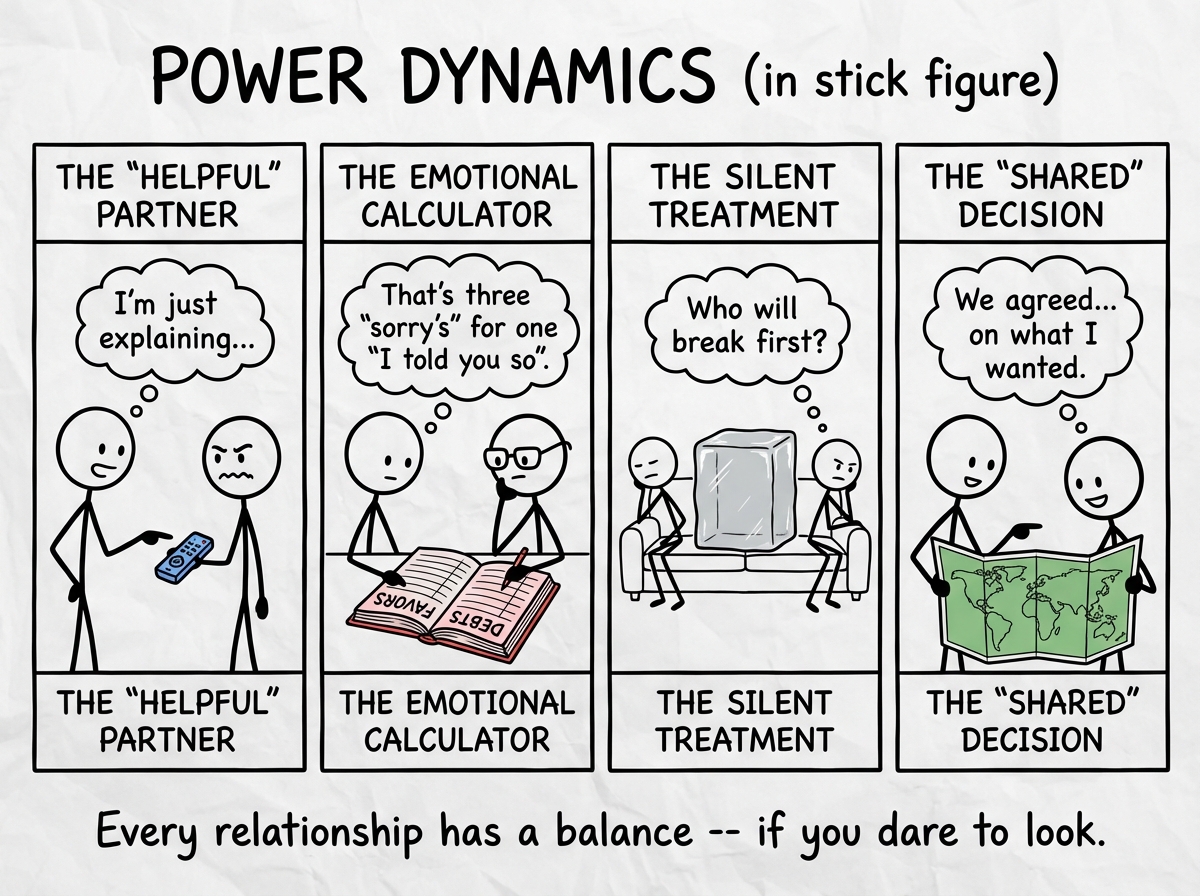
Power dynamics in relationships describe the often invisible ways that influence, decision-making authority, and emotional leverage are distributed between partners. Every relationship has a power structure, but most couples never examine it explicitly, which allows imbalances to calcify into resentment. Social exchange theory, developed by sociologists George Homans and Peter Blau, frames relationships as ongoing negotiations of resources -- emotional support, financial stability, social capital, sexual access -- where the partner who needs the relationship less holds more power. This is sometimes called the 'principle of least interest.' Psychologist John Gottman's research adds nuance: he found that stable couples are not necessarily equal in power, but they are responsive to each other's influence. The key predictor of relationship failure was not power imbalance itself but the refusal to accept influence from a partner, particularly when men refused to be influenced by women. Power dynamics become destructive when they operate unconsciously -- when one partner controls the emotional temperature of the household, dictates social plans, or makes unilateral financial decisions without either person naming what is happening. Making power visible is not comfortable, but it is the only alternative to letting invisible power corrode the relationship from within.
The most dangerous power in a relationship is the kind neither person is willing to name.