The Cracked Vase
Two people try to glue a cracked vase back together, discovering it will never look the same but can still hold flowers -- the Japanese art of kintsugi applied to relationships.

The slow, nonlinear process of repairing trust after it has been broken -- and why the repaired version is never the same as the original.
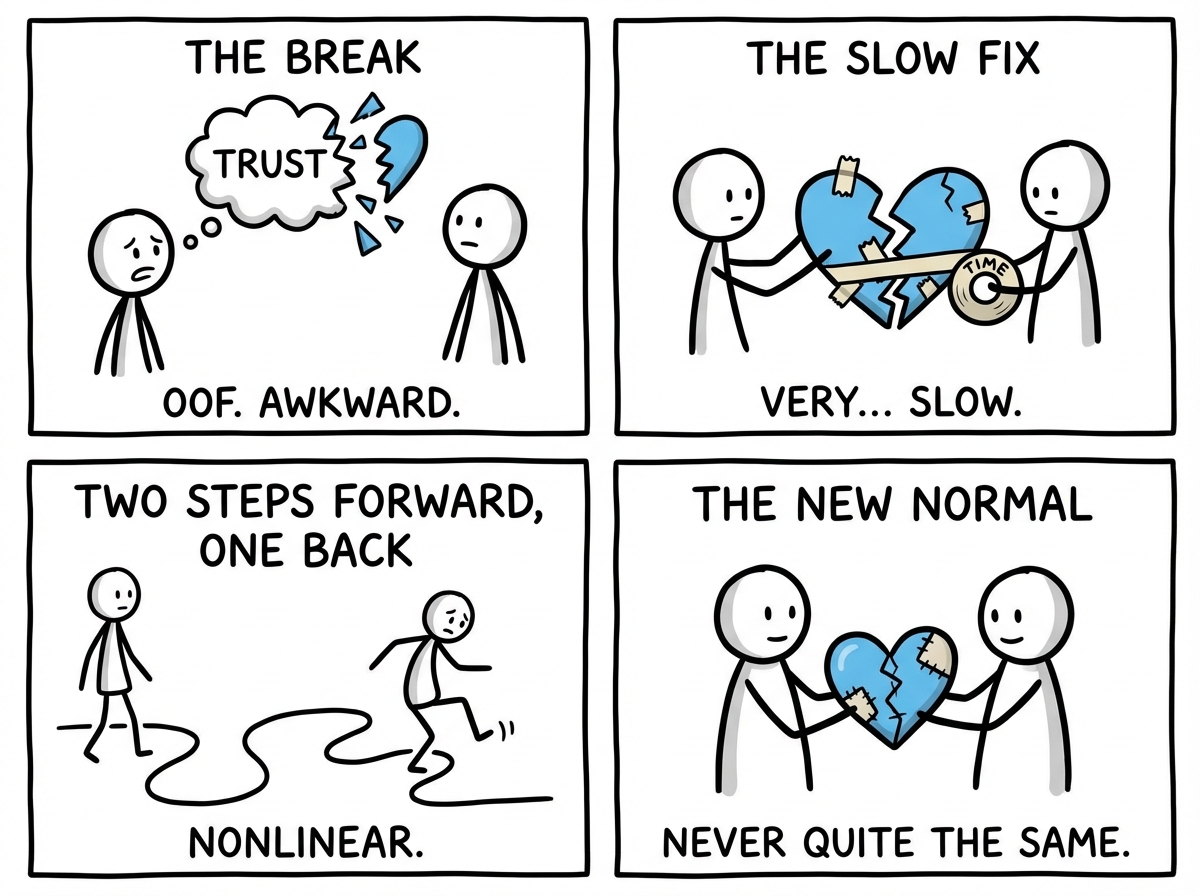
Rebuilding trust is one of the most psychologically demanding things two people can attempt. Researcher John Gottman found that trust is built in small moments -- what he calls 'sliding door moments' -- where one person turns toward or away from the other's needs. Destroying trust can happen in a single act, but rebuilding it requires hundreds of these small moments, accumulated over time, with no guarantee of success. Gottman's research on couples recovering from betrayal identified that repair requires three phases: atoning (the offender taking full responsibility without defensiveness), attunement (learning to listen to the hurt partner's pain without minimizing it), and attachment (slowly rebuilding emotional and physical intimacy). The Japanese art of kintsugi -- repairing broken pottery with gold -- is often used as a metaphor for this process. The repaired object is not the same as the original, but it can be beautiful in a different way. What most people underestimate is the nonlinearity of repair. Progress is not steady. A good week can be followed by a devastating flashback. The person who was betrayed may need to tell the story of their pain many times before the wound closes, and the person who caused the harm must tolerate hearing it without collapsing into defensiveness or shame.
Rebuilt trust is not the same as original trust -- it is something harder won, more honest, and more fragile, but it can still hold.