The Neutral Face Catastrophe
A person interprets a coworker's completely neutral facial expression as proof of hatred, disapproval, and imminent social rejection -- showing how rejection sensitivity distorts ambiguous signals.

Why small signs of disapproval can feel huge, personal, and devastating.
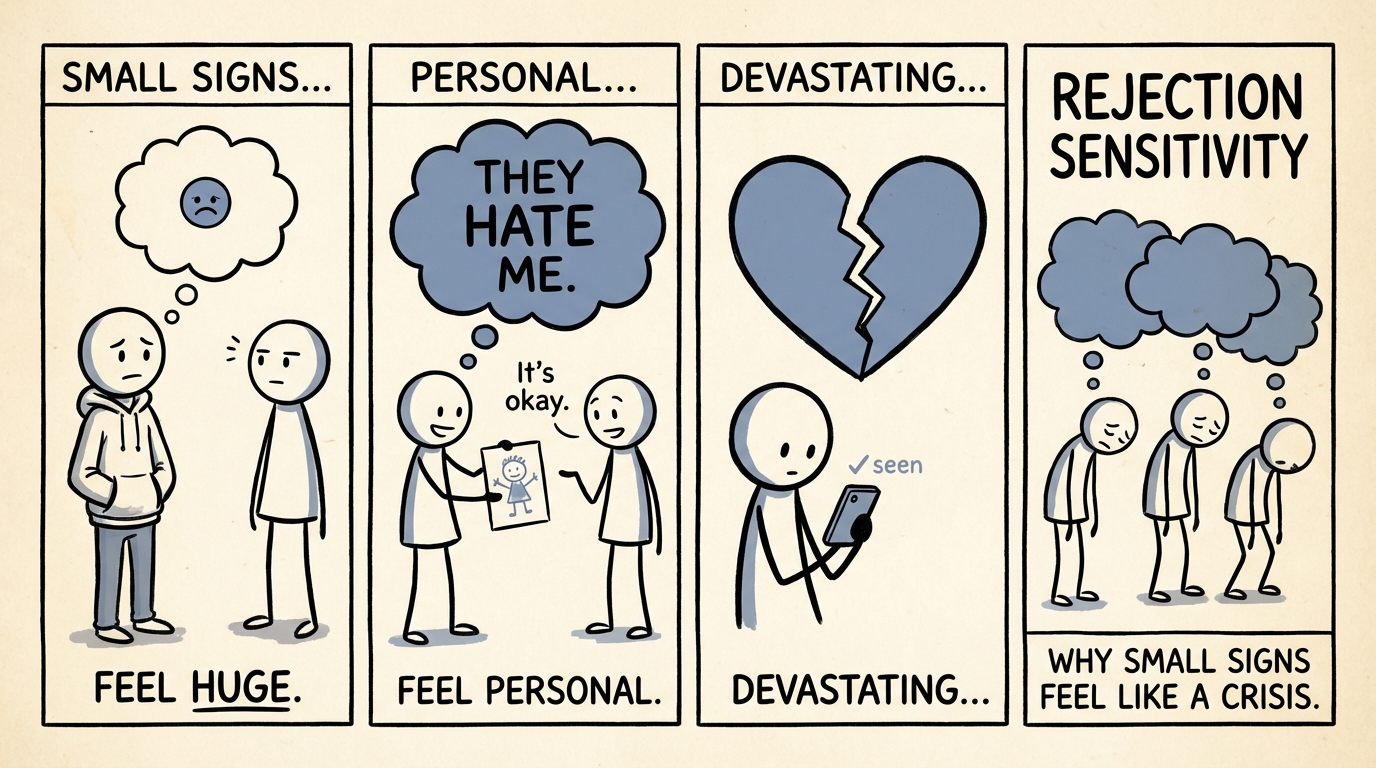
Rejection sensitivity is the tendency to anxiously expect, readily perceive, and intensely react to signs of rejection -- even when no rejection was intended. A friend not texting back feels like proof they do not care. A brief comment from a partner feels like a devastating criticism. A coworker's neutral expression in a meeting feels like disapproval. For people with high rejection sensitivity, these moments are not minor annoyances -- they trigger a cascade of painful emotions that can feel as intense as actual rejection. The concept was developed by psychologist Geraldine Downey, whose research shows that rejection sensitivity often develops from early experiences of rejection, criticism, or conditional acceptance. If love and approval felt unreliable or could be withdrawn at any moment, your brain learned to scan for danger signals constantly. The result is a hypervigilant social radar that detects threats that may not exist, leading to defensive reactions -- withdrawal, anger, or preemptive rejection -- that can damage the very relationships you are trying to protect. Working through rejection sensitivity involves learning to slow down the automatic reaction, reality-test your interpretations, and build a more stable internal sense of worth.
Build a pause between the trigger and the reaction -- long enough to reality-test the story your brain is telling before you act on it.
A stick figure noticing a coworker's neutral face and feeling the familiar pang of 'they hate me' while a small awareness icon lights up in their mind
The stick figure pressing a mental pause button, with a thought bubble showing two columns: 'What my brain says' versus 'What actually happened'
The stick figure choosing to check in rather than withdraw, walking up to the coworker and saying 'Hey, how is your day going?'
The coworker smiling and chatting warmly while the stick figure's rejection alarm fades to a small, manageable signal