The Spiral Staircase
A person climbing a spiral staircase slips back a few steps and believes they are at the bottom again, until they look down and realize they are still much higher than where they started.

A slip is not a fall -- but your brain will try very hard to convince you it is.
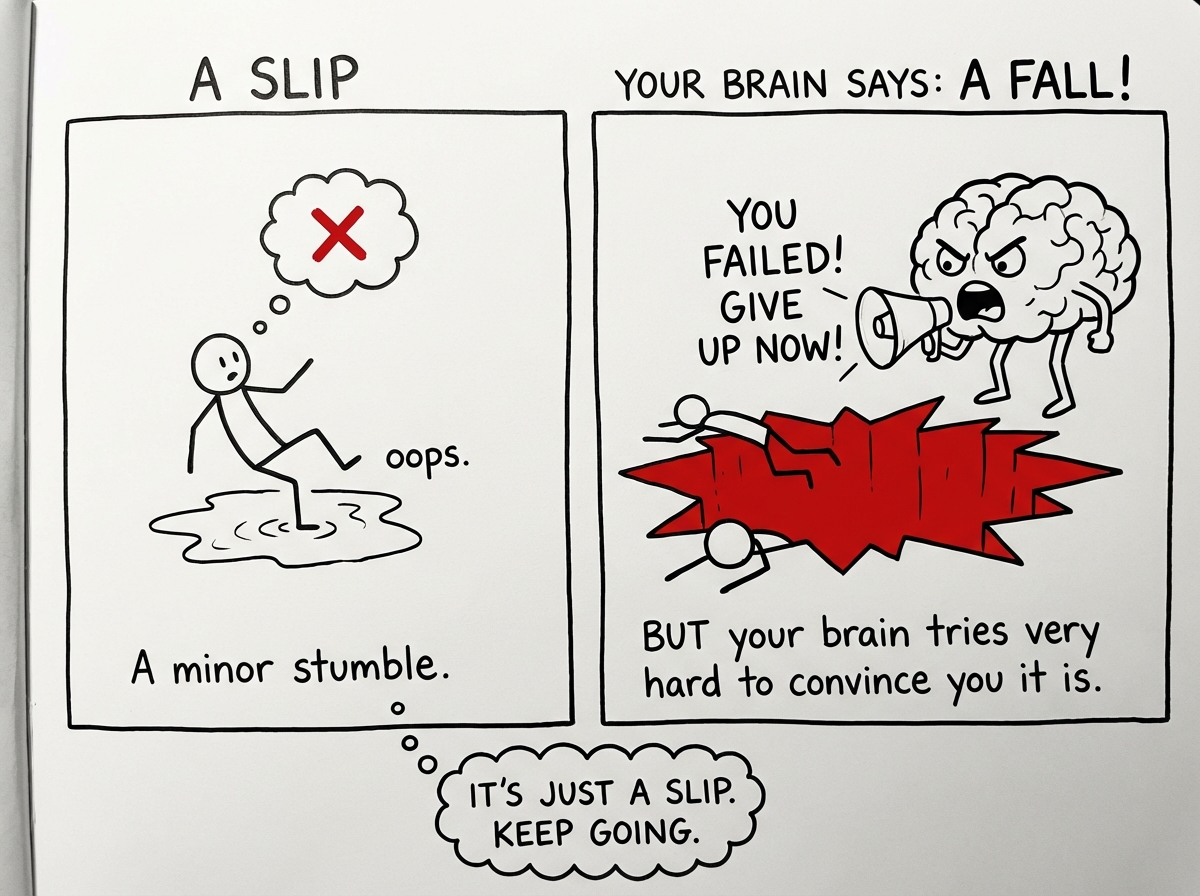
Relapse is one of the most misunderstood events in behavior change. Popular culture treats it as failure -- proof that you are not committed, not strong enough, not ready. But relapse researchers like Alan Marlatt, who developed the Relapse Prevention model, demonstrated that slips are a normal, predictable part of the change process, not evidence of its failure. The critical variable is not whether a slip occurs but how you interpret it. Marlatt identified the Abstinence Violation Effect: when someone who has committed to change slips once, their all-or-nothing thinking kicks in -- 'I already ruined it, so I might as well keep going.' This cognitive distortion turns a single lapse into a full relapse. The Transtheoretical Model of Change, developed by Prochaska and DiClemente, explicitly includes relapse as a stage, not an endpoint. Change is not linear; it is cyclical. A person who relapses after six months of progress has not returned to zero. They have six months of neural rewiring, coping skills, and self-knowledge that did not exist before. The spiral staircase metaphor captures this well: when you slip, you may end up at the same position on the circle, but you are a full level higher than where you started. Understanding relapse psychology removes the shame that turns stumbles into collapses.
A slip is data, not a verdict -- and the spiral staircase always leaves you higher than where you started.