The Love-Shaped Fix
A person plugging another person into an outlet in their chest like a charger, desperate to reach 100% -- but the charge never holds.

When another person becomes your drug of choice.
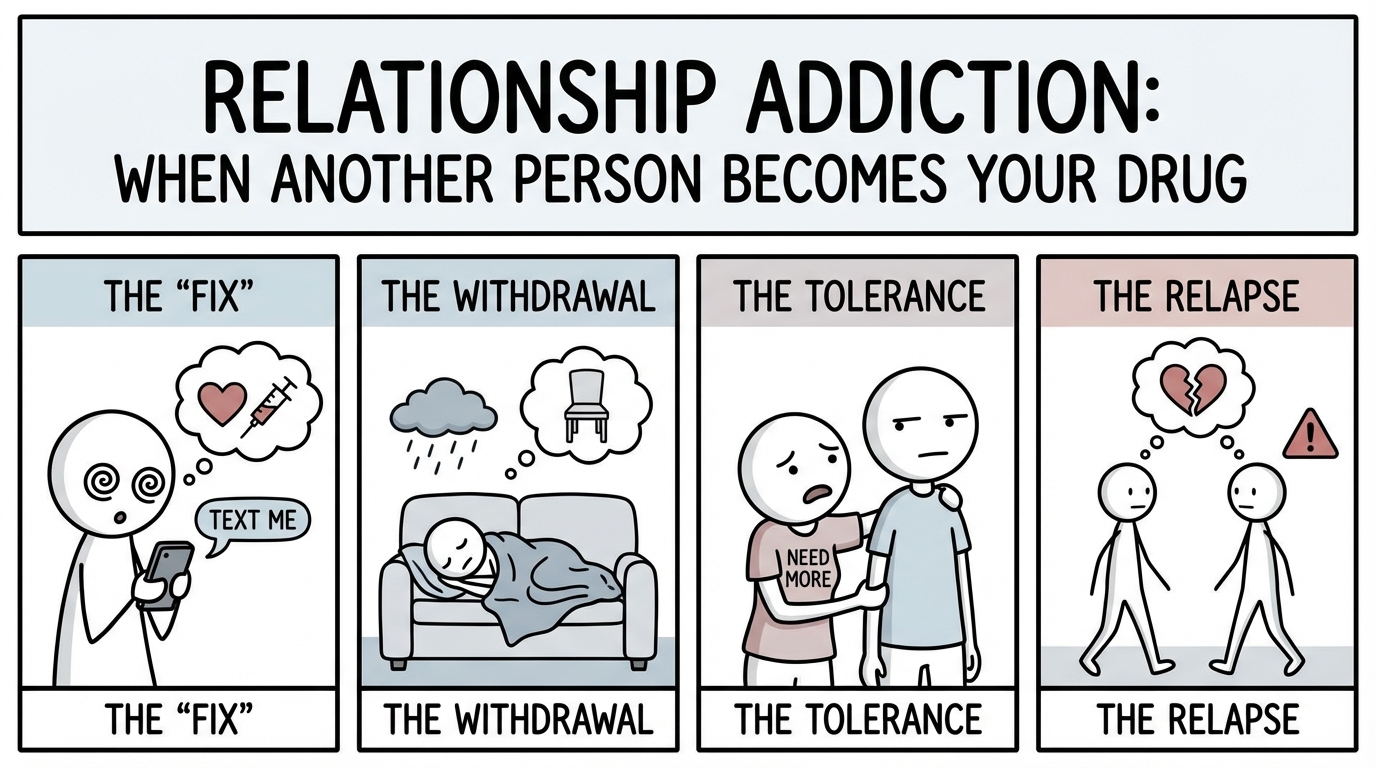
Relationship addiction is the compulsive need to be in a relationship -- any relationship -- in order to feel okay. It is not the same as loving someone deeply or wanting partnership. It is the inability to tolerate being alone with yourself, the frantic search for another person to fill a void that no other person can actually fill. When you are in the grip of relationship addiction, being single feels like being broken. The end of a relationship feels like withdrawal. And the beginning of a new one provides a high so intense it can override every red flag in the room. At its core, relationship addiction is often rooted in attachment wounds. If you grew up learning that your worth depended on someone else's approval, attention, or presence, your nervous system may have wired itself to equate being loved with being safe -- and being alone with being in danger. Psychologist Pia Mellody, who pioneered work on love addiction, described it as using another person as a source of emotional regulation the way someone else might use a substance. The other person becomes responsible for your self-esteem, your emotional stability, and your sense of identity. This is an enormous burden to place on another human being, and it almost always leads to the very abandonment and heartbreak you were trying to avoid. Healing from relationship addiction does not mean swearing off love. It means learning to be a whole person first -- someone who wants a relationship rather than someone who needs one to survive.
Healing means learning to be a whole person first -- someone who wants a relationship rather than someone who needs one to survive.
A stick figure looking at the empty socket in their chest after a relationship ends, resisting the urge to immediately find someone new to plug in
The stick figure sitting alone, uncomfortable but curious, exploring who they are without someone else's validation powering them
The stick figure building their own internal power source -- hobbies, friendships, self-knowledge, therapy -- the battery slowly charging from within
The stick figure in a relationship but standing on their own feet, plugged into themselves, the other person beside them as a partner, not a charger