The Conditional Love Equation
A person calculates their worth like a math equation -- adding points for achievements and subtracting them for failures -- never realizing the equation itself is the problem.

The beliefs that shape what you think you deserve in love, work, and life.
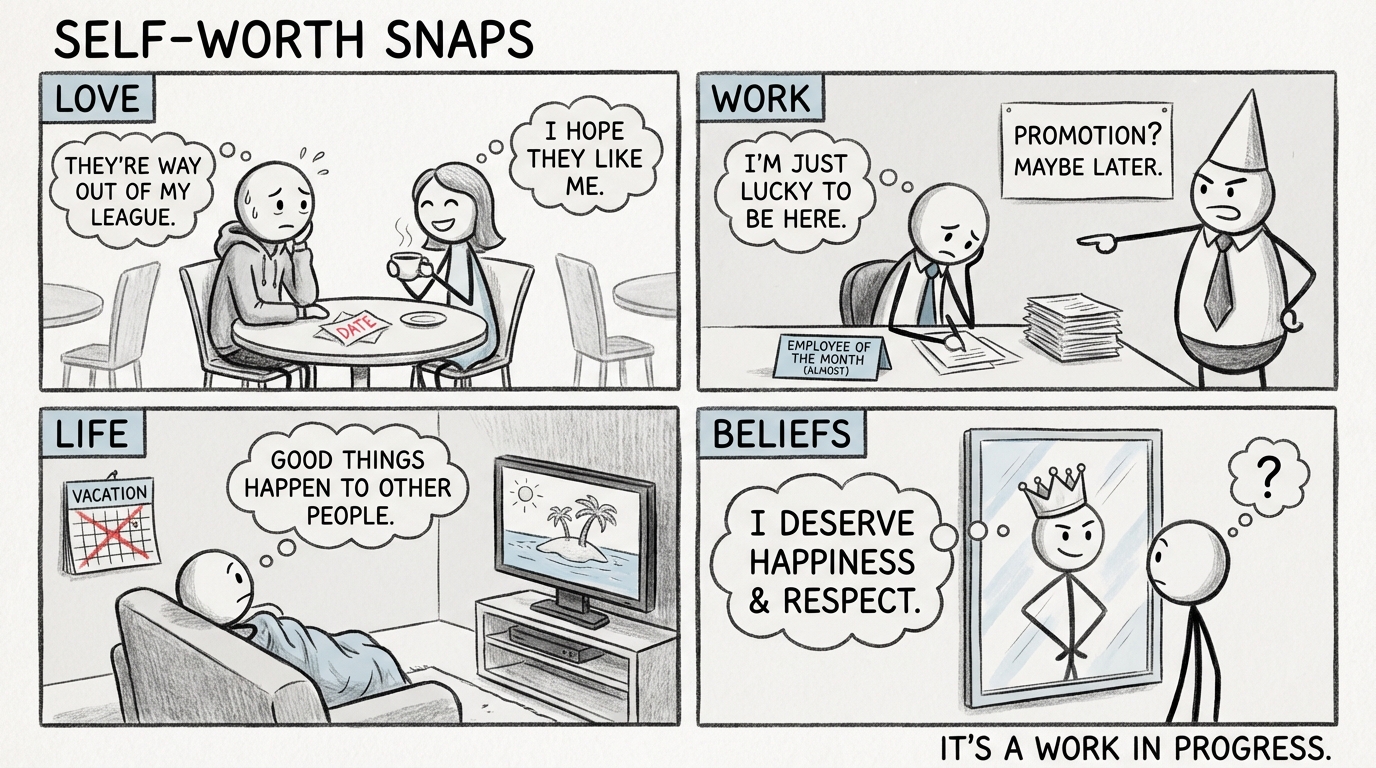
Self-worth is your internal sense of being good enough and deserving of love, belonging, and respect -- regardless of what you achieve, how you look, or what others think of you. It is different from self-esteem, which tends to fluctuate based on external performance and feedback. Self-worth is deeper: it is the baseline belief about whether you matter. When self-worth is low, everything becomes conditional. You believe you have to earn love, prove your value, or be useful to justify your existence. Low self-worth drives patterns like overworking, staying in toxic relationships, settling for less than you want, and tolerating treatment you know is not okay. It often originates in early experiences where your value felt tied to what you did rather than who you were -- conditional love, comparison to siblings, or environments where affection had to be earned. Rebuilding self-worth is not about affirmations or positive thinking. It is about slowly updating the core beliefs that were installed in you before you had a say, through experiences that contradict the old story.
Rebuilding self-worth means slowly proving to yourself that you matter even when you are not performing, producing, or pleasing.
A stick figure staring at the worth equation on a chalkboard, slowly writing 'What if I erased the equation entirely?' underneath it
The stick figure erasing one variable at a time from the equation -- 'job title,' 'others' approval,' 'appearance' -- and still standing
The stick figure resting on a bench doing nothing productive, practicing the radical act of existing without earning it
The stick figure looking in a mirror with a simple thought bubble: 'Enough' -- no equation, no conditions, no performance required