The Spotlight Effect
A person makes a small mistake and feels like a literal spotlight turns on them while the entire world stares and judges -- showing how shame magnifies exposure far beyond reality.

The painful feeling that convinces you something is wrong with you at your core.
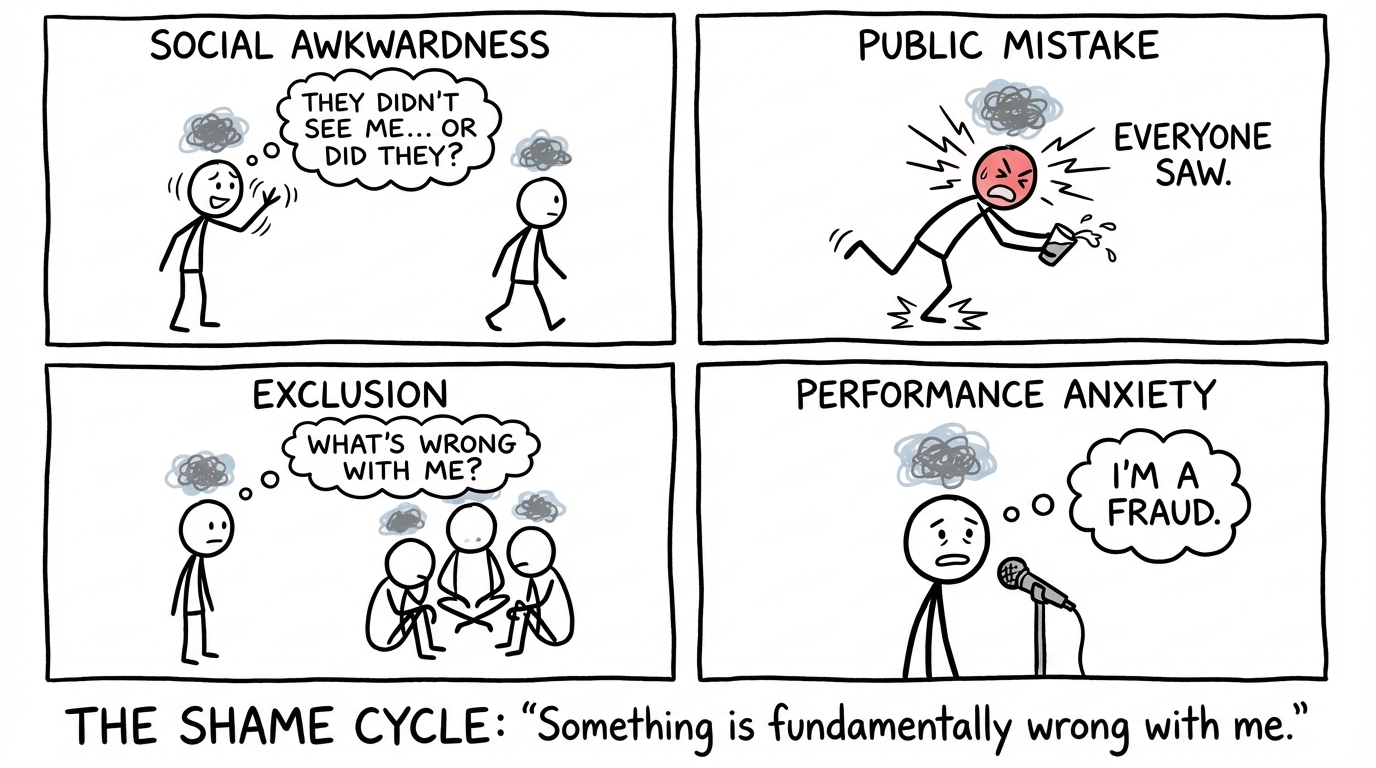
Shame is the deeply painful feeling that there is something fundamentally wrong with you -- not just that you made a mistake, but that you are a mistake. Researcher Brene Brown draws a critical distinction between guilt and shame: guilt says 'I did something bad,' while shame says 'I am bad.' This distinction matters because guilt can motivate change, but shame paralyzes. When you are in shame, you want to hide, disappear, or become invisible. Shame often develops in childhood through experiences of humiliation, harsh criticism, neglect, or conditional love. Over time, it becomes an internal lens that colors how you see yourself and how you interpret the world. Shame drives many destructive patterns: perfectionism (trying to outrun the feeling of being flawed), people-pleasing (earning worth through approval), addiction (numbing the pain), and isolation (hiding so no one sees the 'real' you). The antidote to shame is not willpower -- it is connection. Shame cannot survive being spoken aloud to someone who responds with empathy.
Shame cannot survive being spoken aloud to someone who responds with empathy -- connection is the antidote, not perfection.
A stick figure hiding in a dark corner after a mistake, shame cloud overhead, wanting to disappear
The stick figure taking a shaky step toward a trusted friend and saying 'I need to tell you something I am ashamed of'
The friend responding with warmth and empathy, saying 'That does not change how I see you' while the shame cloud visibly shrinks
The stick figure standing in full light, still imperfect, but no longer hiding, with the shame cloud reduced to a wisp