The Glass Bridge
A person stands at the edge of a glass bridge over a canyon, being asked to walk across it, while every past betrayal has left cracks in the glass they can still see.

The deep difficulty of relying on others when past experience has taught you that people are not safe.
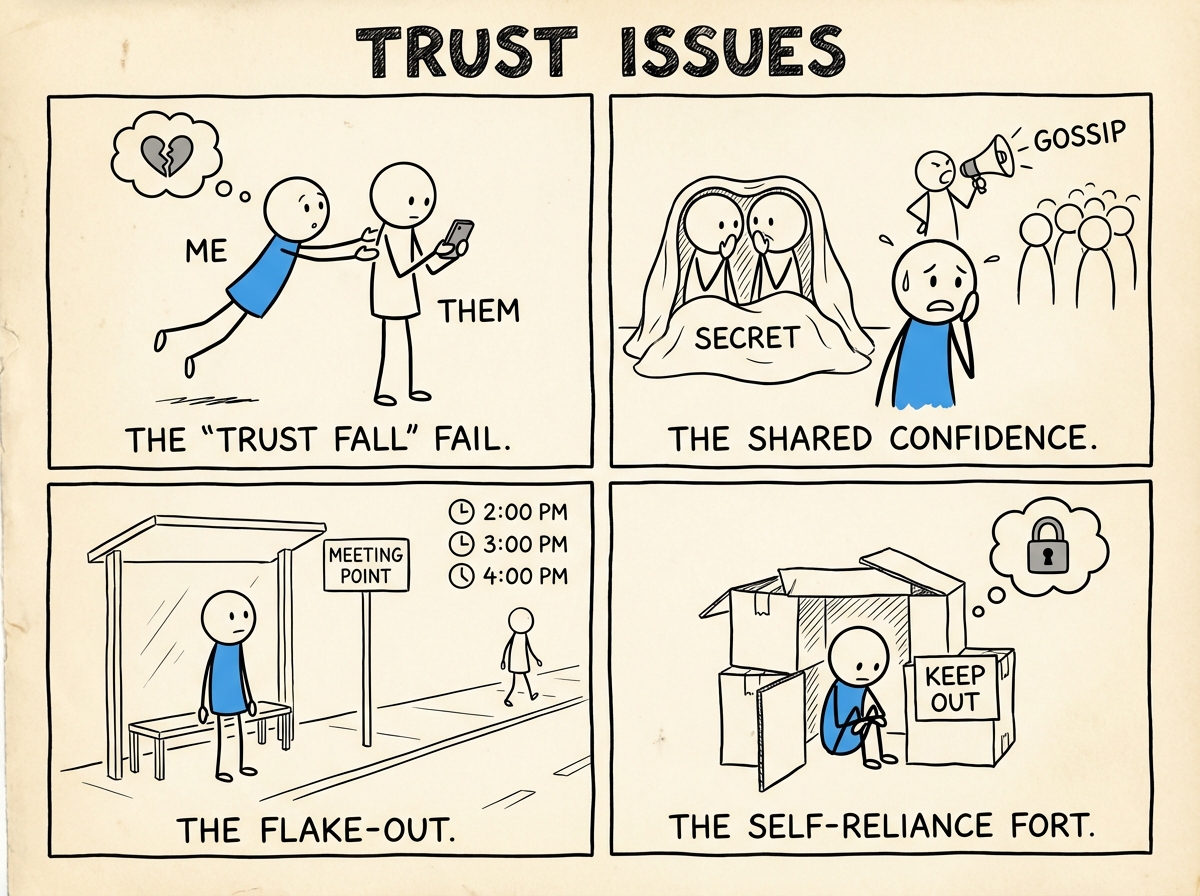
Trust issues are not a character flaw -- they are a learned survival response. When someone you depended on broke a promise, lied, abandoned you, or betrayed your confidence, your brain filed that experience as evidence: people are dangerous. Psychologist Erik Erikson identified trust vs. mistrust as the very first developmental stage, suggesting that the ability to trust begins forming in infancy based on whether caregivers are consistent and reliable. Attachment researchers like John Bowlby and Mary Ainsworth showed that early disruptions in trust create internal working models -- mental blueprints that predict whether future relationships will be safe or threatening. These blueprints operate largely outside conscious awareness, meaning you can genuinely want to trust someone while your nervous system screams that it is not safe. The result is a painful double bind: isolation feels lonely but predictable, while closeness feels desirable but terrifying. Trust issues do not mean you are broken. They mean your brain learned its lessons too well from people who were not worthy of the trust you gave them.
Trust issues are not proof that something is wrong with you -- they are proof that something went wrong around you.