The Boundary Guilt Trap
A person sets a healthy boundary and then immediately feels crushing guilt, as if saying no makes them a bad person.

The invisible lines that protect your energy, identity, and well-being in every relationship.
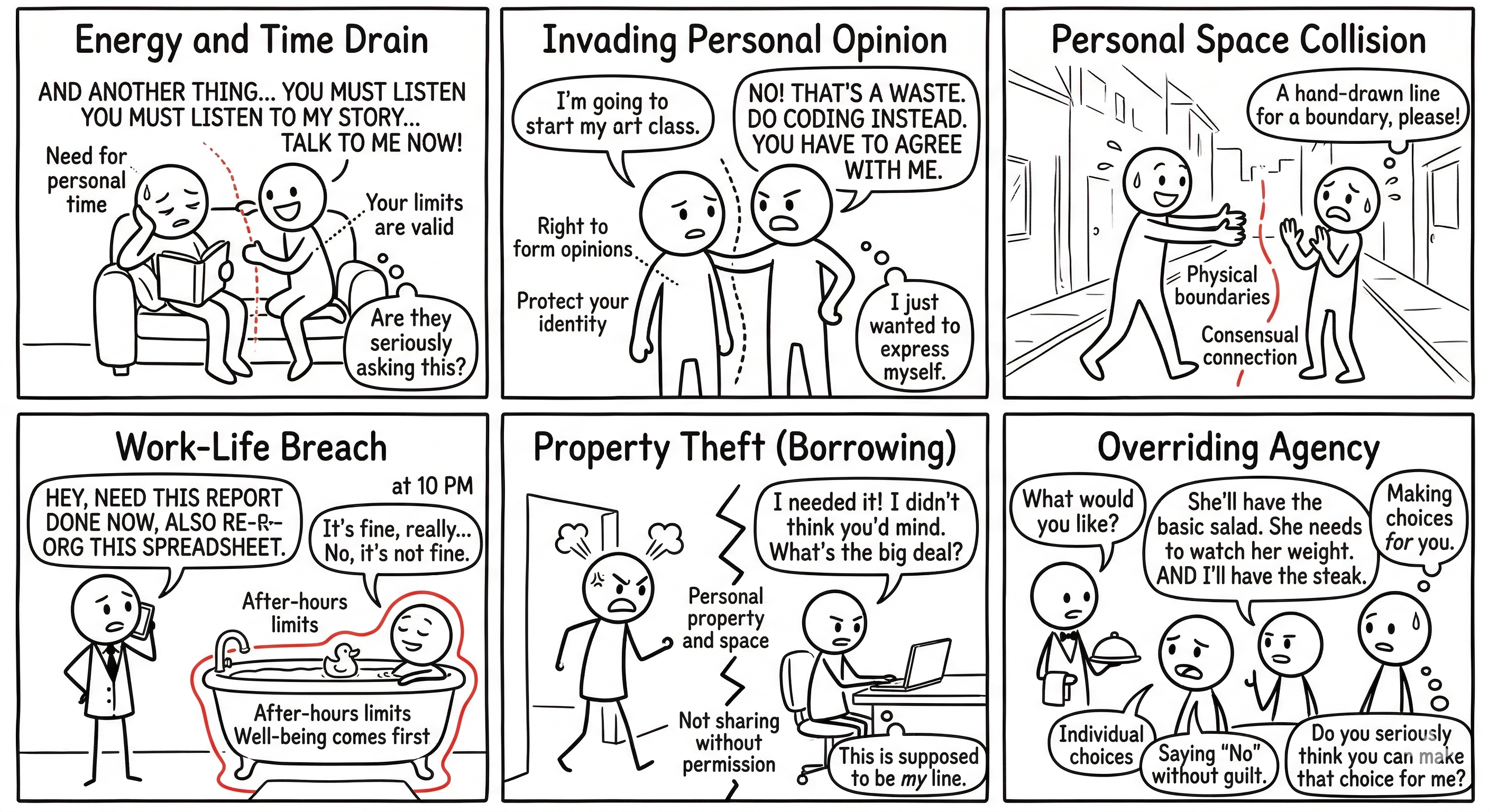
Boundaries are the limits you set to protect your physical, emotional, and mental well-being. They define where you end and another person begins. Healthy boundaries are not about building walls or being selfish -- they are about clearly communicating what is acceptable and what is not. Without boundaries, you may find yourself overcommitting, feeling resentful, or losing your sense of self in relationships. Boundaries can be flexible or firm depending on the situation, and they apply to every area of life: work, friendships, family, and romantic relationships. Learning to set and maintain boundaries is one of the most important skills in psychology, and it is something most people were never explicitly taught. The good news is that it is a skill you can develop at any age.
A boundary is not a punishment for the other person -- it is a statement of what you need to stay healthy in the relationship.
A stick figure noticing they feel resentful and exhausted, with a thought bubble reading 'I keep saying yes when I mean no'
The stick figure practicing in the mirror, saying 'I care about you, and I can not do that' with a nervous but steady expression
The stick figure calmly saying 'I am not available for that' to someone who looks surprised but not hurt
The stick figure relaxed at home with energy to spare, having protected their time, with a small satisfied smile
A person sets a healthy boundary and then immediately feels crushing guilt, as if saying no makes them a bad person.
The important difference between setting healthy boundaries that allow connection and building emotional walls that shut everyone out.
An employee says yes to every request, takes on everyone else's work, and ends up burned out while their coworkers leave on time.