The Midnight Fridge Therapist
A person standing at an open fridge at 2am, not hungry but looking for something the fridge cannot provide -- comfort, control, or calm.

When food becomes the feeling manager.
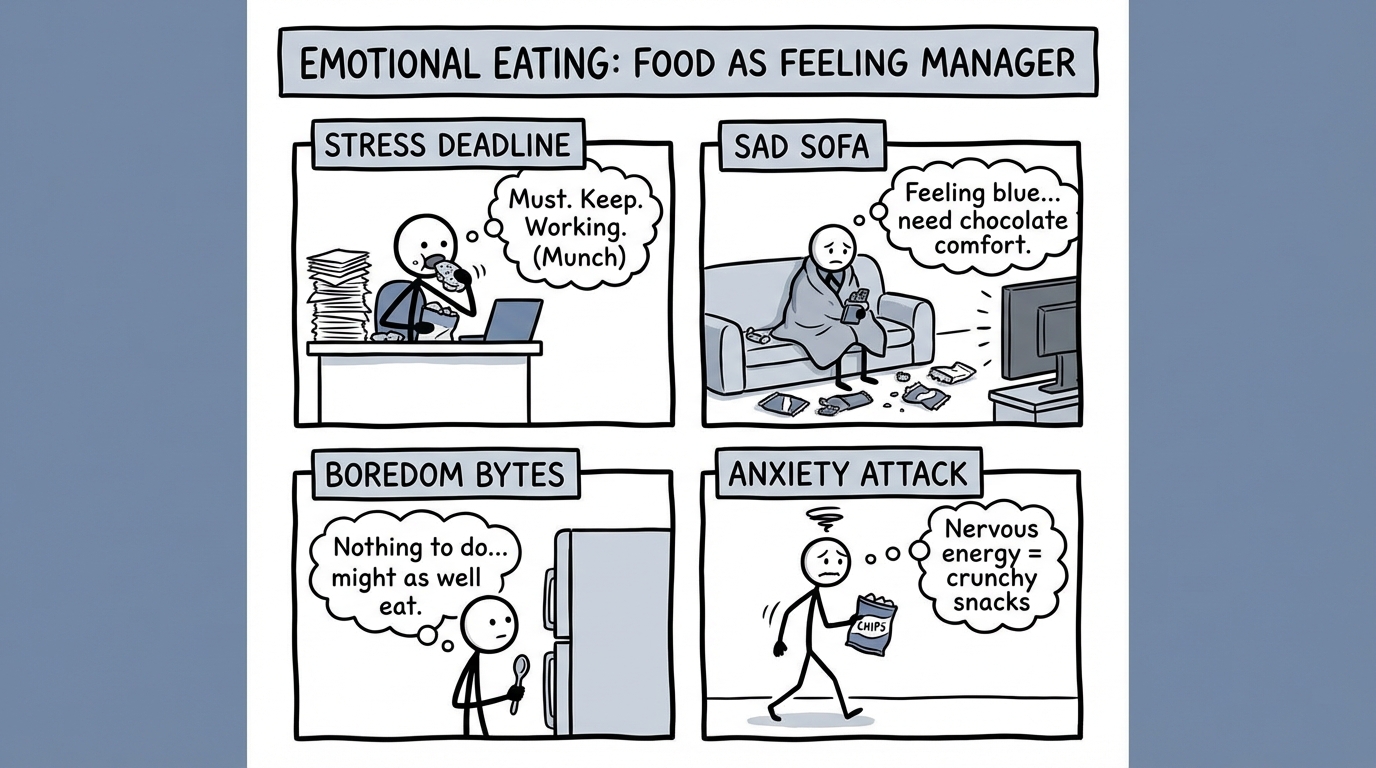
Emotional eating is the practice of using food to manage, suppress, or soothe emotions rather than to satisfy physical hunger. It is reaching for the chips not because your body needs fuel but because your heart needs something it does not know how to ask for -- comfort, control, relief from stress, or a brief moment of pleasure in an otherwise overwhelming day. Nearly everyone does this sometimes, and that alone is not a crisis. But when food becomes your primary coping mechanism -- your first and only response to sadness, anxiety, boredom, or loneliness -- it starts to carry a weight it was never designed to bear. Psychologically, emotional eating often serves as a form of self-soothing that traces back to early attachment patterns. Research by psychologist Brené Brown and others has linked emotional eating to difficulty with emotional regulation and distress tolerance -- the skills that allow you to sit with uncomfortable feelings without immediately trying to fix or escape them. The cycle is often reinforced by shame: you eat to numb a feeling, then feel ashamed for eating, which creates a new uncomfortable feeling you then try to numb with more eating. Breaking this cycle is not about restriction, diets, or willpower -- all of which tend to intensify the problem. It is about developing a relationship with your emotions that does not require a middleman. When you can feel your feelings directly, food gets to go back to being just food.
When you can feel your feelings directly, food gets to go back to being just food.
A stick figure standing in front of the open fridge at night, pausing with hand on the door, asking themselves 'Am I hungry or am I feeling something?'
The stick figure closing the fridge and sitting down at the kitchen table, placing a hand on their chest, naming the feeling: 'lonely'
The stick figure calling a friend, writing in a journal, or wrapping themselves in a blanket -- choosing comfort that matches the actual need
The stick figure eating a meal the next day with genuine enjoyment, food being just food again, the feeling from last night having passed on its own