The Procrastination-Shame Cycle
A person procrastinates on an important task, feels shame about procrastinating, and then uses that shame as a reason to procrastinate even more -- creating a vicious cycle.

The invisible hand that pulls you away from the things you want most.
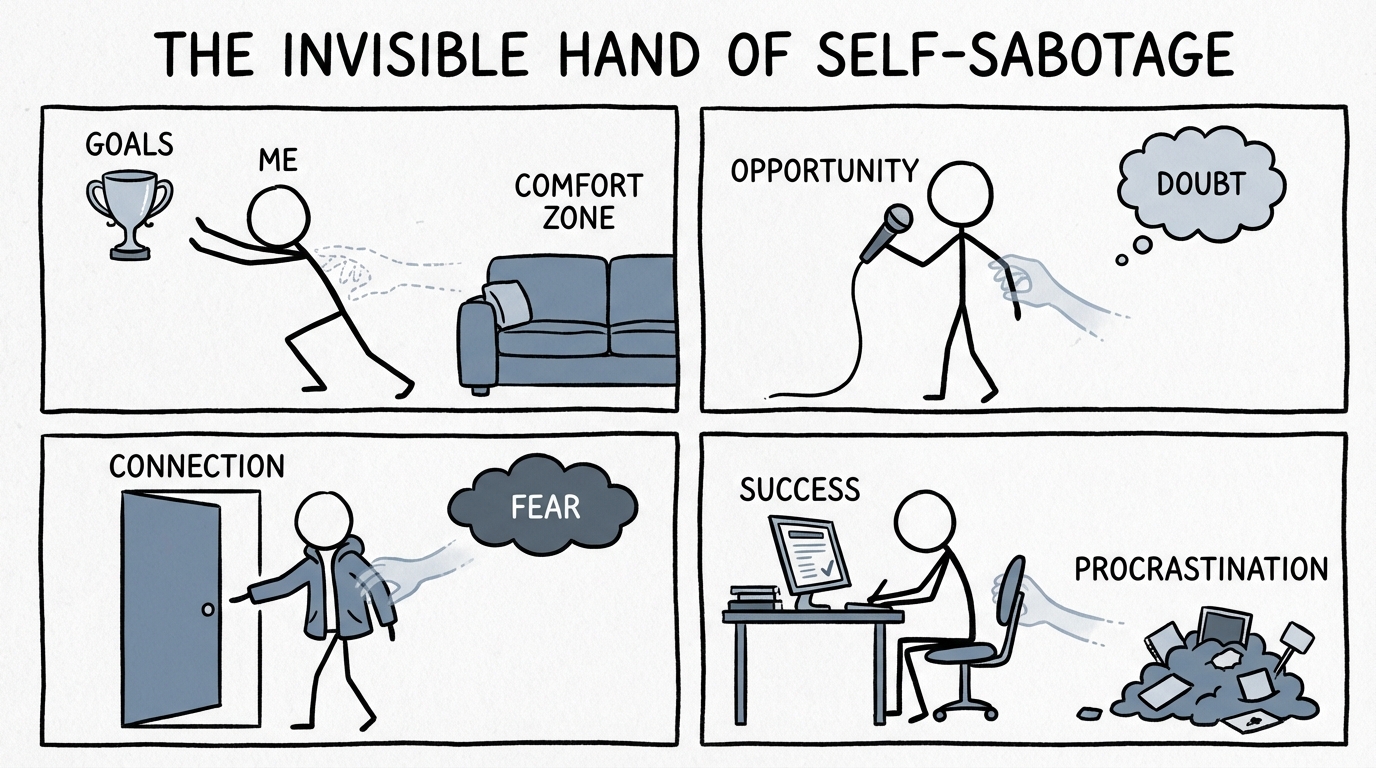
Self-sabotage refers to the patterns of thought and behavior that undermine your own goals, desires, and well-being -- often without you realizing it. It can look like procrastinating on an important project, picking a fight right when a relationship is going well, or quitting just before a breakthrough. At its core, self-sabotage is usually driven by an unconscious belief that you do not deserve success, happiness, or love. It can also be a protective mechanism: if you destroy something before it can be taken from you, you feel a false sense of control. Common forms include procrastination, perfectionism, substance use, chronic lateness, and pushing people away. The frustrating part is that self-sabotage is often invisible in the moment -- you only see the pattern looking back. Awareness is the first and most important step. Once you can name the behavior and connect it to the underlying fear, you can begin to make different choices.
Breaking self-sabotage starts with noticing the urge to destroy something good and choosing to sit with the discomfort of having it instead.
A stick figure noticing good things happening and feeling the familiar urge to ruin them, pausing to label the feeling: 'This is the sabotage impulse'
The stick figure sitting with hands in lap, visibly uncomfortable, choosing not to pick the fight or miss the deadline despite the pull to do so
The stick figure letting the good thing continue -- the relationship deepens, the project ships -- looking surprised it survived
The stick figure smiling cautiously, holding something good, with a thought bubble reading 'I am allowed to have this'
A person procrastinates on an important task, feels shame about procrastinating, and then uses that shame as a reason to procrastinate even more -- creating a vicious cycle.
A person unconsciously destroys an opportunity or relationship right when things are about to go well, because success feels more threatening than failure.