The Scroll That Ate Tomorrow
A phone screen grows into a whirlpool consuming hours of a person's day while their real goals sit dusty on a shelf behind them.

Your brain's reward system was built for scarcity -- and the modern world has hacked it wide open.
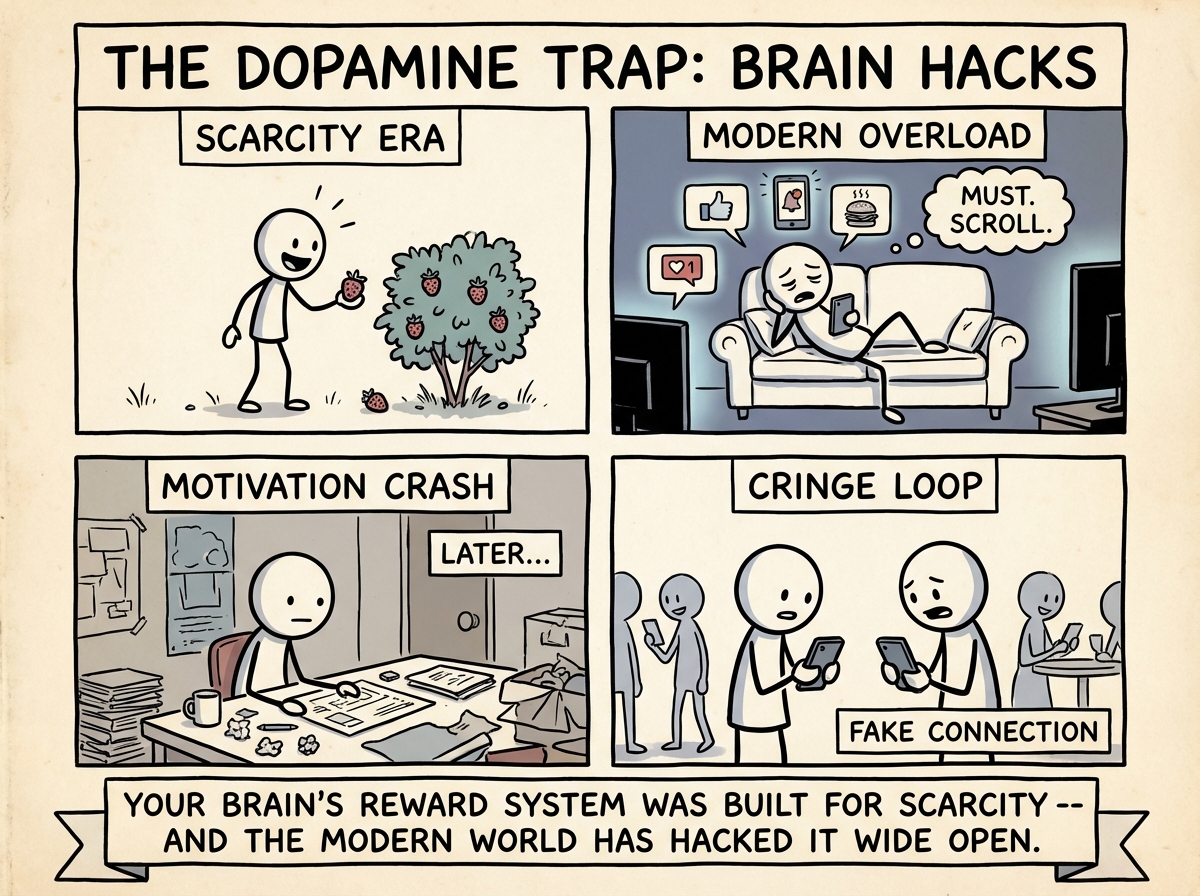
Dopamine is the most misunderstood neurotransmitter in popular psychology. It is not the 'pleasure chemical' -- it is the anticipation chemical. Neuroscientist Dr. Andrew Huberman and researcher Dr. Anna Lembke have clarified that dopamine drives wanting, not liking. It is the neurological engine of motivation, the signal that says 'that thing over there might be worth pursuing.' The problem is that this system evolved for a world of scarcity -- intermittent food sources, unpredictable social rewards, rare novelty. The modern world delivers dopamine hits on demand: social media infinite scrolls, streaming autoplay, notifications engineered to trigger anticipation loops. When the brain is flooded with easy, high-frequency dopamine, it downregulates its own receptors to compensate, creating a state Lembke calls the 'dopamine deficit.' The result is that natural rewards -- finishing a project, having a conversation, taking a walk -- feel flat and unrewarding by comparison. This is not laziness; it is neurochemical recalibration. Your motivation system has been hijacked by superstimuli that deliver reward without effort. Recovery involves what Lembke calls a 'dopamine fast' -- not eliminating pleasure, but restoring the balance between effort and reward so that meaningful activities can compete with engineered ones again.
Dopamine is not broken -- it is doing exactly what it was designed to do in a world it was never designed for.