The Gold Star Treadmill
A person runs on a treadmill collecting gold stars that evaporate immediately, while another person walks slowly enjoying the scenery and discovering lasting fulfillment.

Gold stars get you started -- but they quietly kill the thing that keeps you going.
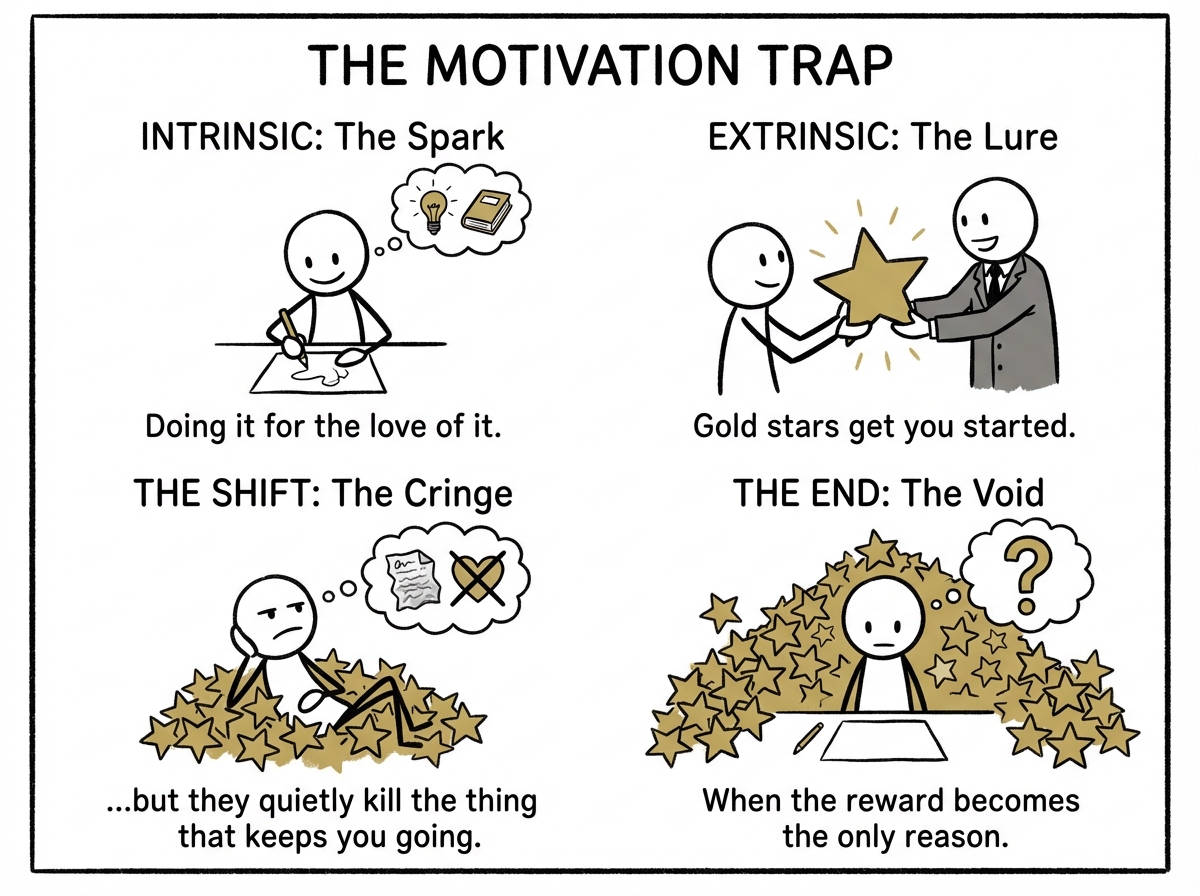
Self-determination theory, developed by psychologists Edward Deci and Richard Ryan, draws a fundamental distinction between intrinsic motivation -- doing something because it is inherently interesting, satisfying, or meaningful -- and extrinsic motivation -- doing something for an external reward like money, grades, or approval. The research is clear and counterintuitive: adding external rewards to intrinsically motivated behavior often undermines the motivation rather than enhancing it. This is called the 'overjustification effect,' first demonstrated in Deci's landmark 1971 study where paying people to solve puzzles made them less likely to solve puzzles for free afterward. The external reward replaced the internal reason. This does not mean all extrinsic motivation is destructive. Ryan and Deci's taxonomy identifies a spectrum from purely external regulation ('I do it because I will be punished if I do not') through identified regulation ('I do it because I understand why it matters') to integrated regulation ('I do it because it aligns with who I am'). The healthiest motivation systems blend intrinsic interest with internalized values. The danger zone is sustained reliance on external validation -- gold stars, likes, bonuses, applause -- as the primary engine of effort. When the rewards stop, so does the behavior. And worse, the original love for the activity may have been quietly extinguished along the way.
The most dangerous reward is the one that makes you forget why you loved the thing before anyone was watching.